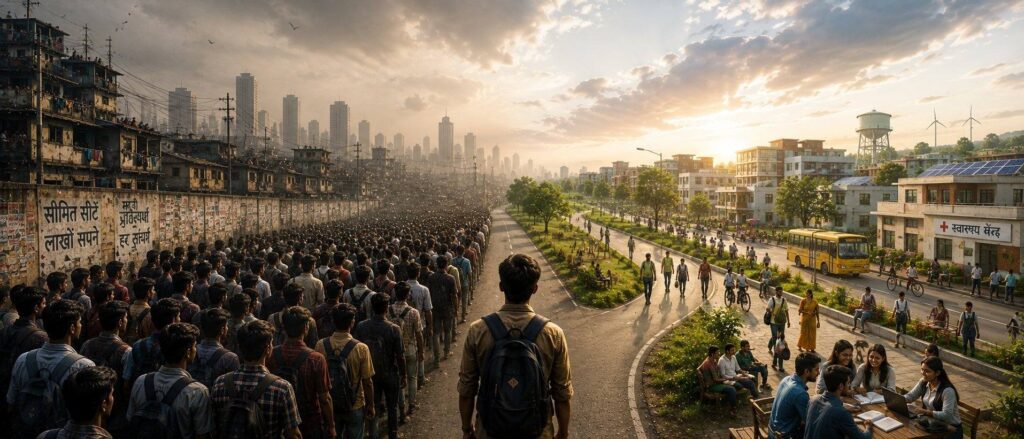
Selling Optimism – AI Generated Image
There is nothing wrong with optimism.
There is nothing wrong with inspiration either.
A person who watches a story about someone overcoming poverty and decides to work harder has not done anything wrong. A young student who watches 12th Fail and decides that failure does not have to define their life may have received exactly the encouragement they needed. A poor contestant on Kaun Banega Crorepati who wins a life-changing amount of money can become a powerful symbol of possibility.
The problem begins somewhere else.
The problem begins when exceptional stories are presented so frequently that people start confusing possibility with probability.
And perhaps more importantly, when society starts telling people that if they work hard enough, they will necessarily succeed, it quietly turns structural failure into personal failure.
This is where optimism can become dangerous.
Not because hope is bad.
But because hope without statistics can become a substitute for reality.
The story we keep telling ourselves
Indian popular culture has always loved the story of the person who starts with almost nothing and rises through extraordinary effort.
The poor student becomes an officer.
The struggling family discovers a hidden talent.
The ordinary contestant wins a fortune.
The boy from a small town reaches an elite institution.
The person everyone underestimated eventually proves everyone wrong.
These stories are emotionally powerful because they are about human agency. They tell us that circumstances do not have to determine destiny.
And that message has value.
But there is a statistical problem that entertainment almost never has to confront.
What happened to everyone else?
For every extraordinary success story, there may be thousands or millions of people whose stories are much less dramatic.
They worked hard.
They were intelligent.
They sacrificed.
They studied.
They showed up every day.
They did everything that inspirational culture told them to do.
And they still did not get the seat.
Not because they were lazy.
Not because they lacked character.
Not because they did not believe in themselves.
Simply because there were not enough seats.
That distinction is enormous.
Imagine one million equally capable people
Take a competitive examination.
Imagine, purely as a thought experiment, one million candidates.
Now make the experiment even more favourable to the idea of merit.
Give every candidate the same intelligence.
The same IQ.
The same quality of education.
The same coaching.
The same amount of time.
The same financial circumstances.
The same physical and mental health.
The same determination.
The same number of hours available for preparation.
Let us even assume that every candidate works equally hard.
Now suppose there are only 1,000 positions.
What happens?
Nine hundred and ninety-nine thousand people don’t get the position.
They cannot all be stupid.
They cannot all be lazy.
They cannot all lack discipline.
They cannot all have insufficient determination.
The problem is mathematical.
There are one million people competing for one thousand positions.
The selection process necessarily produces enormous numbers of unsuccessful people even if the entire population is exceptionally capable.
This is the part of competition that inspirational stories rarely show.
They show the winner.
They rarely show the 999,000 equally capable people who went home.
UPSC provides a real-world example
This is not merely a hypothetical problem.
The Civil Services Examination is one of India’s clearest examples of the difference between individual ability and available opportunity.
In the 2023 examination, the government reported 1,143 vacancies across the IAS, IFS, IPS and other Group A and Group B services. UPSC initially recommended 1,016 candidates, with a further 120 later recommended from the reserve list.
The important point is not the exact number.
The important point is what the number represents.
There are vastly more people capable of preparing seriously for prestigious government careers than there are positions available.
And therefore, failure to become an IAS officer is not equivalent to failure as a human being.
Someone can be exceptionally intelligent, disciplined and hardworking and still lose a competition for a simple reason:
Someone else got the seat.
This is what happens whenever the supply of qualified people greatly exceeds the supply of desirable positions.
It is not a moral judgment.
It is not necessarily a measurement of human worth.
It is an allocation mechanism operating under scarcity.
The uncomfortable economics of competition
We often speak about competition as though competition itself creates opportunity.
It does not.
Competition determines who receives an opportunity when the opportunity is scarce.
That distinction matters.
If there are 100 jobs and 100 qualified people, the problem is relatively straightforward.
If there are 100 jobs and 100,000 qualified people, something different happens.
The additional 99,900 people do not disappear.
They still need food.
They still need housing.
They still need healthcare.
They still need dignity.
They still need employment.
They still have families.
They still have ambitions.
And they still have to live with the psychological consequences of being told, repeatedly, that they simply need to “work harder.”
The result can become an enormous social competition for positions that are inherently limited.
Education becomes competitive.
University admissions become competitive.
Government examinations become competitive.
Jobs become competitive.
Housing becomes competitive.
Good schools become competitive.
Healthcare can become competitive.
Even basic urban infrastructure can become competitive.
A ticket. A seat. A room. A job. A place in a queue. A place in a city.
Everything becomes a contest.
And when almost everything becomes a contest, competition stops being merely an incentive for excellence.
It becomes a way of life.
Competition is good. But is unlimited competition good?
Competition has enormous benefits.
It can encourage innovation. It can reward efficiency. It can prevent complacency. It can push people to improve themselves. It can make institutions better.
Nobody should seriously argue that all competition is bad.
But competition has diminishing returns.
There is a point at which adding more competitors does not produce proportionately more excellence. It simply increases the number of people fighting for the same prize.
Economists and sociologists have long studied this phenomenon through ideas such as positional competition.
Some things are valuable precisely because only a limited number of people can possess them.
A prestigious university seat is positional. A government post is positional. A top corporate position is positional. A house in an extremely desirable neighbourhood is positional. A rank in an examination is positional.
If one person moves from rank 10 to rank 5, society has not necessarily created five times as much value. Often, one person has simply moved ahead of another.
This creates a peculiar phenomenon.
People can collectively work harder and harder without proportionately increasing the number of desirable positions.
Everyone can obtain more degrees. Everyone can take more coaching. Everyone can study longer. Everyone can collect certificates. Everyone can become more competitive.
But if the number of good jobs does not grow at the same rate, the result is not universal prosperity.
It is an arms race.
The arms race nobody talks about
Consider two students competing for one medical seat.
One studies eight hours a day. The other studies ten.
The first starts studying twelve hours. The second starts studying fourteen.
Soon, both are exhausted.
Neither has necessarily become dramatically more intelligent.
They have simply raised the cost of competing.
Now imagine millions of people doing the same thing.
This produces an educational arms race.
Coaching becomes necessary because everyone else is taking coaching. A degree becomes insufficient because everyone else has a degree. A master’s degree becomes necessary because everyone else has one. Internships become necessary because everyone else has internships.
Certificates multiply. Preparation periods become longer. Families spend more money. Young people become anxious.
And eventually, the qualification itself may tell us less about absolute ability than it once did.
The ILO’s India Employment Report 2024 describes India’s youth employment challenge in this broader context: education has expanded, but the transition from education into productive employment remains difficult, while the labour market does not generate enough high-quality opportunities for everyone entering it.
This is not an argument against education.
It is an argument against pretending that education alone can solve a shortage of opportunities.
What happens to the losers?
This is the question inspirational culture rarely asks.
What happens to the people who tried?
The first failure may be manageable. The second can be painful. The third can become an identity crisis.
After several attempts, the person may begin asking:
“What’s wrong with me?” “I worked harder than before.” “I followed all the advice.” “I sacrificed my twenties.” “Why didn’t it happen?”
This is where the mythology of merit can become psychologically cruel.
If society repeatedly tells people:
Work hard → believe in yourself → never give up → success will come
then the person who does all four things and still fails has very few explanations left.
The failure gets internalised.
Perhaps I am not good enough. Perhaps I am stupid. Perhaps I am unlucky. Perhaps everyone else is better. Perhaps I have wasted my life.
But sometimes the correct answer is much simpler:
There were not enough positions.
This is not merely an emotional problem. High-stakes competitive examinations can create substantial academic and psychological pressure. Research on Indian students has associated intense competition and examination pressure with stress, anxiety and poorer psychological well-being.
If a society converts every major life opportunity into a tournament, losing begins to feel like personal rejection.
But losing a tournament is not necessarily evidence of inadequacy.
Sometimes there are simply too many players.
The KBC problem
Consider Kaun Banega Crorepati.
The programme can be inspiring.
A contestant from a difficult economic background appears on television, answers questions and potentially wins money that can transform an entire family’s life.
There is nothing wrong with celebrating that.
But imagine the statistical reality behind the television screen.
India contains hundreds of millions of people with aspirations. Millions experience poverty or economic insecurity. Millions are intelligent. Millions are hardworking. Millions are capable of extraordinary things.
But only a tiny fraction will appear on a television show and receive a life-changing financial opportunity.
The television programme necessarily selects exceptional stories.
That is what television does.
But the audience can accidentally mistake a selection of exceptional outcomes for a representation of normal outcomes.
This is essentially a form of survivor bias.
We see the person who made it.
We don’t see the enormous population of people who tried, struggled and remained where they were.
And this matters enormously when the audience is poor.
Because if a person watches enough stories of miraculous upward mobility, they may begin to believe that their own breakthrough is just around the corner.
Sometimes it is.
But probability matters.
Hope should not require statistical illiteracy.
12th Fail is a beautiful story. It is not a statistical model.
The same distinction applies to films such as 12th Fail.
The story is powerful because it demonstrates perseverance.
It tells us that failure at one stage of life does not have to determine the rest of it.
That is a valuable message.
But there is a dangerous way to interpret it.
A young person can watch the film and conclude:
“If I work hard enough, I too will overcome everything.”
That sentence contains a hidden assumption.
It assumes that effort is the only variable.
It isn’t.
Outcome is influenced by effort, ability, opportunity, timing, family circumstances, geography, health, social networks, economic conditions, institutional structures—and sometimes sheer randomness.
And in a competitive examination, there is another variable that cannot be wished away:
the number of seats.
The correct lesson from a success story should therefore not be:
“Anyone can do it.”
It should be:
“Some people can overcome extraordinary obstacles—and their stories can teach us something.”
Those are very different statements.
The missing film: the other 99,000 people
Imagine making a film about the 99,000 people who worked equally hard but didn’t get the 1,000 available positions.
It would probably be less commercially attractive.
There would be no dramatic final victory. No triumphant music. No officer receiving a posting letter. No family celebrating.
The ending might simply be:
“He tried for four years. He eventually took another job.”
Another candidate might become a schoolteacher. Another might start a business. Another might leave the city. Another might move abroad. Another might remain unemployed for a while. Another might never recover financially from the years spent preparing.
And another might actually have been just as capable as the person who succeeded.
These are not failures of storytelling.
They are the reality of large-scale competition.
Perhaps Indian cinema needs more stories like these.
Not stories designed to destroy hope.
Stories designed to calibrate hope.
The rhetoric of India’s “youth power”
There is another version of this optimism at the national level.
Political leaders frequently describe India’s young population as a demographic dividend, a source of strength, energy and national power.
There is truth in that.
A large working-age population can indeed become an enormous economic advantage.
But a demographic dividend is not created simply by having young people.
Young people need productive work. They need education. They need skills. They need infrastructure. They need capital. They need functioning cities. They need opportunities.
The World Bank has explicitly warned that India’s demographic dividend requires the creation of more and better jobs; employment growth has not kept pace with the growth of the labour force.
That is the critical distinction.
Young people are potential economic power.
They are not automatically economic power.
A large number of young people without sufficient productive employment can become something very different from a demographic dividend.
It can become demographic pressure.
The same demographic fact can therefore be described in two completely different ways.
“India has the world’s largest youth population.” That is optimistic.
“India has an enormous number of young people who need productive livelihoods.” That is realistic.
We need both statements.
But we should never allow the first statement to replace the second.
The population question
This brings us to the uncomfortable subject that India has spent decades trying to discuss without always confronting its full implications:
population.
India’s fertility rate has fallen dramatically.
According to India’s Ministry of Health and Family Welfare, the total fertility rate fell to 2.0 in NFHS-5, below the conventional replacement level of 2.1. Thirty-one of India’s 36 states and union territories were already at or below replacement fertility.
This is an enormous demographic transformation.
But a falling fertility rate does not mean India’s population immediately falls.
Population has momentum.
Even after fertility falls below replacement, large cohorts of young people can continue producing population growth because there are so many people entering reproductive ages.
The United Nations’ 2024 population projections expect India’s population to continue increasing for decades, reaching roughly 1.7 billion around the early 2060s before beginning a decline. India is projected to remain the world’s most populous country throughout this century.
That means the effects of today’s demographic choices are not confined to today.
They are inherited by future generations.
Why are families having fewer children?
It would be wrong to say that fertility has declined only because life has become expensive.
The reality is more complicated.
Family planning programmes and contraceptive access have played an important role. So have female education, urbanisation, later marriage, declining child mortality and changing aspirations.
Economic incentives matter too.
Research on India’s fertility transition has identified the rising cost of raising children, increasing educational expectations and the changing economic value and opportunity costs associated with children as important factors.
And this is where the argument becomes particularly interesting.
Perhaps people are not merely being persuaded to have fewer children.
Perhaps many people are looking at the world around them and making a rational calculation.
“Can I afford to give this child the life I want for them?”
That question changes everything.
Because having a child is no longer simply about keeping another pair of hands in the household.
Parents increasingly understand that raising a child means education, healthcare, housing, transportation, nutrition, digital access, university and eventually employment.
The cost is enormous.
And in a society where almost every desirable resource is fiercely contested, parents may rationally decide that having fewer children allows them to invest more in each child.
That is not necessarily a demographic policy success.
It is also a reflection of the economic environment.
The child who enters a world of competitions
Imagine being born into a society where almost everything important requires competition.
First, you compete for admission to a good school. Then you compete for a good college. Then you compete for a professional course. Then for an internship. Then for a job. Then for a promotion. Then for housing in a desirable city. Then perhaps for your child’s school admission.
And eventually, your own child begins the same cycle.
At some point, the question becomes:
What kind of society are we creating?
Competition is useful when it encourages people to create more value.
But competition becomes destructive when enormous numbers of people are forced to compete for things that cannot be expanded quickly enough.
The distinction is crucial.
If ten restaurants compete for customers, they can all potentially improve and expand the market.
But if one restaurant has ten tables and ten thousand people want those tables at the same time, competition cannot create additional tables.
Someone will simply be excluded.
Now multiply that principle across education, employment, housing and public services.
That is where population size becomes economically relevant.
The goal must ultimately be fewer Indians
This is perhaps the most uncomfortable conclusion of the entire argument.
The goal cannot simply be to create more opportunities for an ever-growing population.
At some point, we have to ask a much more fundamental question:
How many people can India realistically sustain at a high standard of living?
India has more than 1.4 billion people today. That number is extraordinary by any historical or geographical standard. And the argument that India can simply build enough infrastructure, create enough jobs and generate enough economic growth to make a population of this size permanently sustainable deserves much more scrutiny than it usually receives.
There is a difference between surviving with 1.4 or 1.5 billion people and providing those people with a genuinely high quality of life in an environmentally sustainable way.
The first may be possible.
The second is a much more difficult proposition.
India has limited land relative to its population. It faces severe pressure on groundwater in several regions, increasingly stressed urban infrastructure, air pollution, congestion, waste-management problems and enormous demand for energy, housing, food and transportation.
Economic growth can alleviate some of these pressures. Technology can alleviate some of them. Better governance can alleviate some of them.
But none of these things can repeal physical limits.
There is only so much land. Only so much freshwater. Only so much ecological capacity. Only so much space in cities. And ultimately, only so many resources available per person.
A smaller population changes the equation
Imagine two Indias with identical institutions, identical technology, identical productivity and identical natural resources.
One has 1.5 billion people. The other has 700 million.
The second India does not automatically become prosperous.
But almost every scarce resource becomes easier to distribute per person.
There is potentially more land per person. More water per person. More housing per person. More infrastructure per person. More energy per person. More ecological capacity per person.
And, crucially, fewer people competing for each opportunity.
That does not mean population reduction is the only thing India needs to do.
It means that population size is itself a fundamental variable in the equation.
We should stop treating it as though it were irrelevant.
The long-term objective should be demographic contraction
India should not aspire merely to stabilise at today’s population.
It should ultimately aim for a substantially smaller population.
A long-term population in the range of 600–700 million would be far more compatible with the idea of India providing a genuinely high standard of living while remaining within realistic environmental and resource constraints.
That is not a target that can—or should—be achieved quickly.
Nor should it be pursued through coercion.
It would require decades of voluntary fertility decline and a demographic transition spanning generations.
But there is nothing inherently unreasonable about a society deciding that its long-term objective should be fewer people living substantially better lives, rather than continually trying to accommodate more and more people.
Indeed, if India’s population eventually fell from around 1.7 billion to 600–700 million, India would still be one of the largest countries in the world by population.
The objective is not depopulation.
It is demographic correction.
India should also think about its share of the world
There is another useful way of looking at the issue.
India currently accounts for roughly one-sixth of humanity.
That is an extraordinary proportion for a single country.
A long-term objective of keeping India’s population at no more than roughly 4–5% of the world’s population would fundamentally change the demographic relationship between India and the rest of the world.
This is not about believing that Indians are somehow less valuable than other human beings.
Quite the opposite.
The objective should be to ensure that each Indian has access to substantially more resources, space, infrastructure and opportunity.
A smaller population would make that objective considerably easier.
But this is a generational project
The mistake would be to imagine that reducing India’s population is something that can happen within one political cycle.
It cannot.
Even with fertility below replacement level, population momentum means that the total population can continue increasing for decades.
The United Nations currently projects India’s population to peak around the early 2060s at approximately 1.7 billion before beginning a long decline.
And even after the decline begins, reaching a population of 600–700 million would take many additional decades.
That is precisely why demographic decisions made today matter so much.
If the desired endpoint is a substantially smaller population, waiting another thirty or forty years before seriously discussing the long-term objective simply pushes the eventual correction further into the future.
The question is not whether people deserve to exist
This argument can easily be misunderstood.
It is not an argument that individual Indians are a problem.
An individual human being is not a demographic statistic.
A child is not responsible for the population into which he or she is born. A poor family is not responsible for India’s demographic history. And nobody should be treated as less valuable because they were born in a country with a large population.
The argument operates at a completely different level.
Population policy is about aggregate numbers.
One person is not a problem.
One hundred million additional people can create enormous structural consequences.
That is the distinction.
We routinely make similar calculations in economics, environmental planning and public infrastructure.
A single additional car does not destroy a city. Millions of additional cars can.
A single additional consumer does not exhaust a water supply. Millions of additional consumers can.
A single additional household does not transform a housing market. Millions of additional households can.
Scale changes everything.
Fewer people should not mean less ambition
There is also a misconception that population reduction means accepting economic decline.
It does not.
A smaller India could be more prosperous precisely because its economic output would be distributed among fewer people.
The objective should not be: “How can India support 1.5 billion people?”
The more ambitious question is: “How can India eventually provide an exceptionally high quality of life to a much smaller population?”
Those are fundamentally different development philosophies.
The first accepts population as a fixed constraint and asks the economy to keep running faster to accommodate it.
The second recognises population as one of the variables that can itself change.
And if India can eventually have fewer people while maintaining or increasing productivity, the amount of economic output available per person can rise dramatically.
A smaller population can therefore complement economic growth rather than contradict it.
Population reduction should be treated as a success, not a failure
There is something psychologically strange about demographic discussions.
When the population grows, it is often presented as evidence of vitality.
When fertility falls, politicians and commentators sometimes immediately begin worrying about decline.
But why should a smaller population automatically be considered a problem?
If a country has fewer people because families voluntarily choose to have fewer children, while productivity rises, living standards improve and society becomes wealthier per person, that can be a success.
The purpose of an economy is not to maximise the number of people.
It is to improve human welfare.
There is no economic law stating that a country must perpetually increase its population.
A country can become richer, more productive and more technologically advanced while becoming smaller.
Indeed, several advanced economies are already confronting the opposite demographic problem: ageing and population decline.
That creates challenges of its own.
But it does not follow that the answer is to maximise population indefinitely.
The correct objective is to find a demographic structure that allows people to live well.
For India, given the enormous population already accumulated, that almost certainly means a very long period of demographic contraction.
The real danger of extreme competition
Extreme competition produces consequences far beyond disappointment.
It can create:
- chronic educational stress;
- enormous household spending on coaching;
- delayed entry into the workforce;
- credential inflation;
- underemployment;
- anxiety and burnout;
- unhealthy comparison;
- migration pressure;
- family conflict;
- willingness to cheat;
- corruption;
- exploitation by coaching industries;
- status obsession;
- declining willingness to take socially useful but lower-status work;
- and a growing tendency to measure human worth through rankings.
When the prize becomes extremely valuable and the number of prizes becomes extremely small, people have stronger incentives to manipulate the competition.
This is one reason why extreme competition can create fertile ground for cheating, leaks, corruption and other forms of rent-seeking.
The stakes become so high that the competition itself begins to distort behaviour.
The problem is therefore not simply that people are competing.
The problem is that too many people’s entire futures are being placed inside too few competitions.
We should not tell people to stop dreaming
The answer is not pessimism.
That would be another mistake.
A young person should absolutely dream. A poor child should absolutely believe that their circumstances can change. A student should absolutely work hard. A person who has failed should absolutely be allowed to try again.
Hope is psychologically valuable. Optimism can be productive. Perseverance matters.
But these qualities need something that inspirational culture often neglects:
probabilistic thinking.
There is a difference between:
“I can succeed.” and “I am likely to succeed.”
There is also a difference between:
“It is possible.” and “It is probable.”
A mature society should teach people to understand both.
Hope should come with a probability distribution
Suppose someone tells a young person:
“You can become an IAS officer.”
That is true.
But it would be much more responsible to add:
“You can become an IAS officer, but thousands of other capable people are competing for a limited number of positions. Prepare seriously, understand the odds, establish a time limit, develop alternative career paths and do not make your entire identity dependent on the result.”
That is not discouragement.
That is responsible guidance.
The same principle should apply to every major ambition.
Dream. Prepare. Work hard. But understand the distribution.
Understand the number of competitors. Understand the number of positions. Understand the historical probability. Understand what happens if you fail.
And most importantly:
build a life that does not collapse if one competition is lost.
Perhaps our stories need to change
This is where cinema, television and popular culture have an enormous responsibility.
The problem is not that India makes inspirational stories.
India should make them.
The problem is that the inspirational story is often presented as though it represents the normal relationship between effort and outcome.
Perhaps we need another kind of story.
A film about the 500 students who studied for UPSC for three years and did not clear it.
A series about the students who prepared for NEET and eventually chose nursing, physiotherapy, pharmacy or another profession.
A documentary about graduates who were academically excellent but spent years searching for suitable employment.
A story about a family that decides not to measure its child’s worth by a competitive examination.
A film about the person who doesn’t get into the prestigious institution but builds an equally meaningful life somewhere else.
A story about the thousands of contestants who never reach the KBC studio.
A story about the millions of Indians whose extraordinary abilities never become extraordinary careers because the opportunity never arrived.
These stories would not be anti-inspirational.
They might be more inspirational precisely because they would teach resilience without promising miracles.
We need to separate individual responsibility from collective responsibility
There are two truths that can exist simultaneously.
An individual is responsible for making the best possible use of the opportunities available to them.
And society is responsible for ensuring that opportunities are not unnecessarily scarce.
We should not tell a young person: “You failed because you didn’t work hard enough.”
Nor should we tell them: “Nothing is your responsibility.”
Both are simplistic.
The better answer is:
Work hard—but understand the system in which your hard work operates.
If there are not enough jobs, create more productive jobs. If universities are overcrowded, expand quality higher education. If cities are unaffordable, build better cities. If housing is scarce, build housing. If young people are qualified but underemployed, change the structure of the economy.
And if population pressure is contributing to scarcity, recognise population reduction as one of the long-term solutions rather than treating population size as an untouchable constant.
The answer to demographic pressure should be voluntary, rights-based fertility decline, better education, access to contraception, economic development and informed family planning—not coercion.
But neither should we pretend that population is irrelevant.
The uncomfortable truth about population decline
There is another irony here.
For decades, India worried about population growth.
Now that fertility has fallen, parts of the political and economic debate are beginning to worry about ageing and future population decline.
This is why demographic policy must be extremely careful.
The future is not perfectly predictable.
The UN’s projections are projections, not guarantees.
Fertility can fall faster than expected. It can stabilise. It can rise again. Migration can change population structures. Economic development can change family decisions.
Nobody can honestly tell us exactly what India’s demographic structure will look like several decades from now.
But one thing is already visible.
India has moved into a much lower-fertility era, while its total population will remain enormous for decades because of demographic momentum.
The responsible response is therefore neither panic nor complacency.
It is preparation.
And preparation should include a serious conversation about what population India ultimately wants—not merely what population it happens to have.
The most compassionate message may be the most honest one
There is something deeply cruel about telling a person who has failed after years of effort that they simply need to believe more.
Sometimes they already believed enough. Sometimes they worked hard enough. Sometimes they were good enough.
They simply lost a competition in which there were far more qualified participants than available positions.
That does not make their life worthless. It does not make their effort meaningless. It does not make their intelligence irrelevant.
It means only that human potential is not the same thing as available opportunity.
And perhaps that is the lesson our inspirational culture needs to learn.
We should continue telling stories about people who overcome impossible odds.
But alongside those stories, we should tell the stories of everyone else.
The people who worked just as hard. The people who were just as intelligent. The people who were just as deserving. The people who never got the seat. The people who never got the interview. The people who never got onto the television show. The people whose dreams collided with a statistical reality much larger than themselves.
Because there is dignity in acknowledging that reality.
And there is wisdom in understanding it.
Hope is not the enemy. Unqualified hope is.
There is a crucial distinction between pessimism and realism.
Pessimism says: “Don’t try. You will probably fail.”
Blind optimism says: “Try hard enough and you will succeed.”
Realism says: “Try. Work hard. Improve your odds. But understand the odds themselves.”
That is the message that young people deserve.
A person should not abandon ambition simply because the probability of success is low.
Human beings have achieved extraordinary things precisely because some people were willing to attempt things that were difficult.
But society should not systematically hide the probability.
The student preparing for UPSC should know how many candidates compete for how many positions. The student preparing for NEET should understand the distribution of seats. The young person entering a profession should understand employment prospects. The family considering an expensive degree should understand the likely return. The person spending five years preparing for an examination should understand the opportunity cost.
And the person who ultimately fails should understand that failure does not automatically mean inadequacy.
That is what an educated society should provide:
not less hope, but better-calibrated hope.
We need to stop confusing exceptional stories with ordinary life
The fundamental problem with inspirational culture is not inspiration itself.
It is selection.
Television selects the extraordinary contestant. Cinema selects the extraordinary story. Social media selects the extraordinary transformation. The news selects the extraordinary success.
And after consuming thousands of these stories, an ordinary person can develop a completely distorted understanding of probability.
The person sees:
“Someone from Dharavi became rich.” “Someone who failed Class 12 became an IAS officer.” “Someone from a poor family became a billionaire.” “Someone who had nothing became successful.”
All of these things can be true.
But the correct statistical question is:
How many people with similar circumstances did not?
That question is uncomfortable because it removes the emotional magic.
But it is exactly the question that needs to be asked.
If a million people attempt something and one succeeds, the one success is real.
It is also an exception.
Both statements must be held simultaneously.
The final argument
Perhaps we have spent too much time telling individuals to become more competitive and too little time asking whether society has become excessively competitive.
We tell young people to work harder. We tell them to acquire more qualifications. We tell them to develop more skills. We tell them to wake up earlier. Study longer. Prepare better. Never give up. Believe in themselves.
And all of that may be useful.
But there is a limit to how much harder one person can work.
At some point, the problem is no longer individual effort.
It is the ratio between people and opportunities.
If one million people compete for one thousand seats, making the million people work even harder does not create 999,000 additional seats.
If millions of young people enter the labour market but the economy does not create enough productive jobs, telling them to become more employable cannot solve the entire problem.
If a city has more people than its infrastructure can comfortably accommodate, telling everyone to be more patient does not create housing, water or road capacity.
If a country has a population approaching 1.5 billion, simply celebrating its “demographic strength” does not make the underlying demographic pressure disappear.
At some point, arithmetic must enter the conversation.
And arithmetic is not pessimistic.
It is indifferent.
It does not care how inspirational the story is. It does not care how determined the contestant is. It does not care how many motivational videos someone has watched.
A thousand seats remain a thousand seats. A hundred jobs remain a hundred jobs. A finite quantity of water remains finite. A finite amount of land remains finite. And a country with 1.5 billion people remains a country with 1.5 billion people.
That is why optimism needs a foundation in reality.
We should encourage people to dream. We should encourage them to work. We should encourage them to persevere.
But we should also teach them statistics.
We should tell them that exceptional success stories are exceptional. We should tell them that failure is sometimes structural rather than personal. We should tell them that competition has limits. We should tell them that population matters.
And we should have the courage to discuss the possibility that India’s long-term solution may not be to find increasingly ingenious ways of accommodating an enormous population.
It may be to gradually have fewer people.
Perhaps considerably fewer.
Perhaps, over generations, something in the range of 600–700 million.
Not through coercion. Not through treating human beings as disposable.
But through a long, voluntary demographic transition in which smaller families become normal and the population eventually contracts.
Because the objective of civilisation is not to maximise the number of people competing for the same resources.
The objective is to maximise the quality of human life.
And sometimes, achieving that objective requires accepting an uncomfortable truth:
More people do not automatically mean more prosperity.
More competition does not automatically mean more opportunity.
More optimism does not automatically mean more possibility.
And more inspirational stories do not change the statistics.
Hope is good. Hard work is good. Ambition is good.
But hope should not be sold as a substitute for reality.
Hope should tell us what might be possible.
Statistics should tell us what is probable.
And public policy should be concerned with changing those probabilities.
If we genuinely want a better future for the people who will live in India decades from now, perhaps the most optimistic thing we can do today is not to promise every person that they can win the competition.
Perhaps it is to build a country in which far fewer people have to compete so desperately for the same limited opportunities in the first place.
Notes & sources
Figures on the 2023 Civil Services Examination are drawn from official UPSC results and government reporting on vacancies across IAS, IFS, IPS and allied services.
Youth employment context draws on the ILO’s India Employment Report 2024, produced jointly with the Institute for Human Development.
Demographic-dividend commentary draws on World Bank analysis of India’s labour force and job creation.
Fertility figures are drawn from India’s National Family Health Survey (NFHS-5) and the Ministry of Health and Family Welfare.
Long-term population projections are drawn from the United Nations World Population Prospects 2024 revision.