India Guide · Regions
Eastern India: Rivers, Deltas and the Bay of Bengal
This is where the great rivers of the north finally reach the sea.
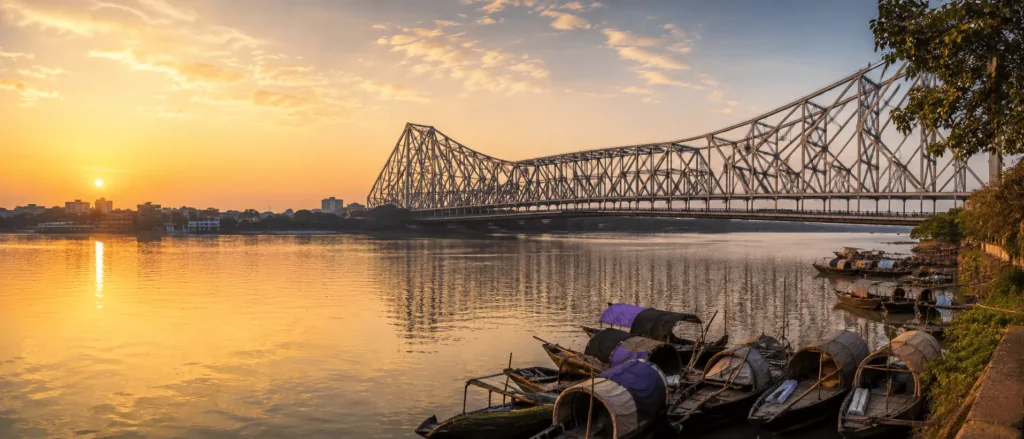
Most descriptions of India move north to south and treat the east as a footnote between Kolkata and the next flight home. That undersells it badly.
Eastern India is where the great rivers of the north — the ones that built the northern plains — finally reach the sea, and that single fact explains an enormous amount of what follows: the fertility, the trade, the vulnerability, and the particular intellectual energy the region became known for.
This guide is built the same way Rajasthan was: geography first, culture as the consequence.
Where the rivers end
By the time the Ganga and the Brahmaputra reach Bengal, they’ve already crossed most of northern India. Here, joined by smaller rivers like the Hooghly, Mahanadi, Damodar and Subarnarekha, they finally slow down, spread out, and deposit millennia of accumulated silt across one of the largest deltas on Earth.
A river doesn’t just carry water. It carries the sediment that builds farmland, the current that carries boats and trade, and — over centuries — the people who follow all of it downstream. Nearly everything distinctive about this region starts with that one geographic fact: this is where the rivers finally arrive.
The delta: fertile and fragile
The soil the rivers leave behind is extraordinarily fertile — rice paddies, fish ponds and waterways define the landscape for as far as you can see, and settlement here has depended on that fertility for thousands of years.
But the same water that makes the delta so productive also makes life here precarious. Monsoon flooding is a near-annual event, not a disaster in the exceptional sense — it’s part of the rhythm people have built their lives around. The Sundarbans, the vast mangrove forest where the delta meets the Bay of Bengal, is one of the most striking examples of this: a landscape genuinely shared between people and tigers, shifting constantly between land and water.
Fertile and fragile at once
Communities across the delta haven’t simply survived the flooding — they’ve built entire agricultural and architectural traditions around expecting it. Raised homestead platforms, flood-tolerant rice varieties and boat-based transport aren’t backup plans. They’re the plan.
Bengal and the sea
Bengal was never only a river civilisation. The Bay of Bengal connected it outward — to Southeast Asia, Sri Lanka, the rest of the Indian coastline, and through wider trading networks, further still.
Ports grew where rivers met the sea, and with them came textile trade, merchant communities, and cities built on the wealth that maritime trade generates. That coastal openness is exactly what eventually drew European trading companies — Portuguese, Dutch, French and finally British — each looking for a foothold in one of the richest textile-producing regions in the world. Calcutta, as it became, was the culmination of that long process: a city built where a river met a sea that connected to everywhere else.
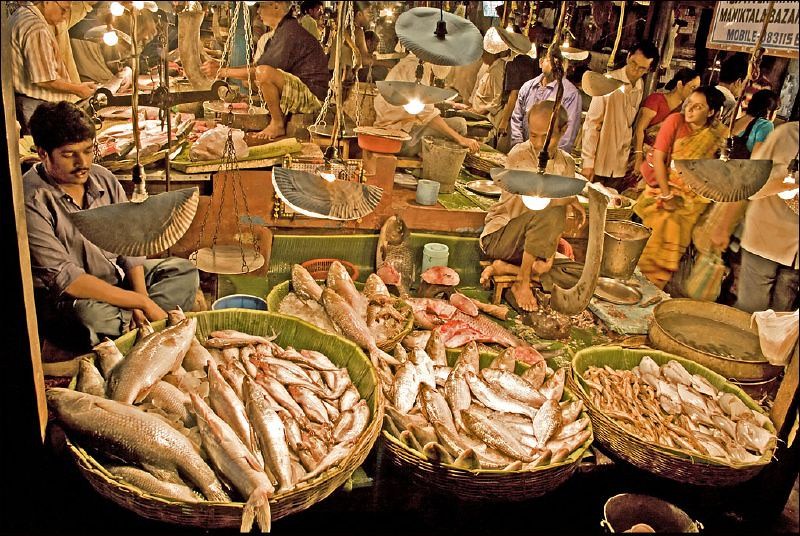
Fish Market Kolkata
Rice, fish and the Bengal kitchen
Bengali cuisine reads, more than almost any regional cuisine in India, like a direct translation of the landscape into food. Rice and fish sit at the centre of it for the same reason the delta looks the way it does: an abundance of water, ponds and rivers made both staples rather than luxuries.
Mustard oil, a defining flavour of Bengali cooking, comes from a crop suited to the region’s soil. Hilsa, the fish most associated with Bengali cuisine, is prized specifically because it migrates up these rivers to spawn. Panta bhat — rice soaked overnight in water — is a dish born directly out of a hot, humid climate and a rice surplus. Even the region’s famous sweets, built on chhena, fresh curdled milk, reflect a dairy tradition layered onto a rice-and-fish foundation.
Food here is geography you can taste.
Odisha: between river and sea
Odisha sits between the delta and the deep south, with its own coastline, its own maritime history, and its own religious tradition distinct from Bengal’s.
Long before it was Odisha, this was Kalinga — and Kalinga’s role in Indian history is hard to overstate. The Mauryan emperor Ashoka’s invasion and conquest of Kalinga was, by his own later account, so brutal that it changed him. He turned from further military conquest toward Buddhism and a philosophy of non-violence that would go on to shape Indian political thought for centuries.
The war that changed an emperor
Ashoka’s Kalinga War is one of history’s rare, well-documented turning points where a conqueror looked at the cost of his own victory and changed course. His edicts, carved into rock and pillar across the subcontinent afterward, are still among the earliest surviving records of Indian governance.
Centuries later, Odisha developed its own distinct devotional tradition around Jagannath, centred on the great temple at Puri — a tradition with its own rituals, its own annual chariot festival, and its own relationship between deity and devotee unlike anywhere else in India. Nearby, the Sun Temple at Konark and the Lingaraj Temple in Bhubaneswar show a regional architectural style shaped by the same religious and political currents, distinct from both Bengal and the temple traditions further south.
Bengal Renaissance and Kolkata
Under British rule, Calcutta became something unusual: a colonial capital that also turned into one of the most significant centres of Indian intellectual life.
The 19th and early 20th centuries saw what’s often called the Bengal Renaissance — a period of literary, artistic, religious and social reform that produced figures like Rabindranath Tagore, and reshaped Indian ideas about education, literature, religion and eventually nationalism itself. Colonial Kolkata’s architecture, printing presses, universities and reform movements weren’t simply imposed from outside — they became raw material that Bengali intellectuals used to build something distinctly their own, and that intellectual energy still shapes how the city thinks of itself today.
Partition and its legacy
Bengal’s modern history can’t be understood without Partition — and Bengal was partitioned twice: administratively in 1905, and then again, far more consequentially, in 1947, when the region was divided along religious lines into West Bengal and East Pakistan, which later became Bangladesh.
The human cost was immense — mass migration, divided families, and a redrawing of borders that separated communities, languages and cultures that had coexisted for centuries. That history still shapes the region today: in Kolkata’s demographics, in the cultural and linguistic ties that still cross the modern India-Bangladesh border, and in the way Bengali identity itself was reshaped by a line drawn in 1947. It isn’t a footnote to the region’s story. It’s one of the central events in it.
Bihar: empires and enlightenment
Bihar sits west of Bengal along the same river system, and deserves to be understood on its own terms rather than as a prelude to it.
This was the heartland of Magadha, one of ancient India’s great kingdoms, and its capital Pataliputra became the seat of the Mauryan Empire — the same empire Ashoka would later rule. It’s also, in a real sense, one of the birthplaces of Indian religious thought: the Buddha attained enlightenment at Bodh Gaya, the Jain tradition associated with Mahavira took root in the region, and Nalanda became one of the ancient world’s great centres of learning, drawing students from across Asia centuries before European universities existed. Few regions anywhere have produced this concentration of religious and political transformation in one place.
Jharkhand: forests and minerals
Jharkhand, carved out of southern Bihar, tells a different kind of story — one about forests rather than rivers.
This is Adivasi country: home to tribal communities with their own languages, agricultural traditions and forest economies that predate the modern state by centuries. The same forested plateau that once sustained these communities turned out, in the 20th century, to sit on some of India’s richest mineral deposits — coal, iron ore, and more — making the region central to India’s industrial development, often in tension with the communities and forests that were there first.
Places across eastern India
Kolkata
A colonial capital turned intellectual capital — still the cultural centre of gravity for the entire region.
Puri
Home to the Jagannath Temple and its extraordinary annual chariot festival.
Konark
The Sun Temple, one of India’s most ambitious pieces of religious architecture.
Bodh Gaya
Where the Buddha is said to have attained enlightenment — still a major pilgrimage site today.
Sundarbans
The world’s largest mangrove forest, shared between people, tigers and tide.
Patna
Ancient Pataliputra, once capital of the Mauryan Empire, now Bihar’s modern capital.
Travelling eastern India
Modern eastern India is Kolkata’s continuing reinvention, Bhubaneswar’s growth as a planned city, Patna and Ranchi finding their own economic identity, and a region still deeply connected — culturally, linguistically and through family ties — to Bangladesh across the border. Industrialisation sits alongside centuries-old pilgrimage routes, often within the same state.
- Season. Winter (November–February) is the most comfortable time to visit. The monsoon (June–September) brings the flooding the delta depends on, but travel gets harder.
- The Sundarbans require permits and are best visited with an organised boat trip, not independently.
- Bihar’s Buddhist circuit — Bodh Gaya, Rajgir, Nalanda and Vaishali — connects well as a single, deeply worthwhile route.
- Kolkata to Odisha (Puri, Konark, Bhubaneswar) is a natural, well-connected extension for anyone starting in Bengal.
- Trains remain one of the best ways to move across the region; distances are large and well served by rail.
- Bengali sweets and street food are genuinely worth building time around, not squeezing in.
Next in the India Guide: South India, where the monsoon and the Indian Ocean shaped a different civilisation entirely.
Curious about a trip through Bengal, Odisha or Bihar, and want someone who explains as much as they show? Message me on WhatsApp.