India Guide — Northeast India
Where India Meets Southeast Asia
Not India’s far corner — a mountain crossroads where Tibet, Myanmar, Bhutan, Bangladesh and dozens of distinct cultures have been meeting, trading and mixing for far longer than the border has existed.
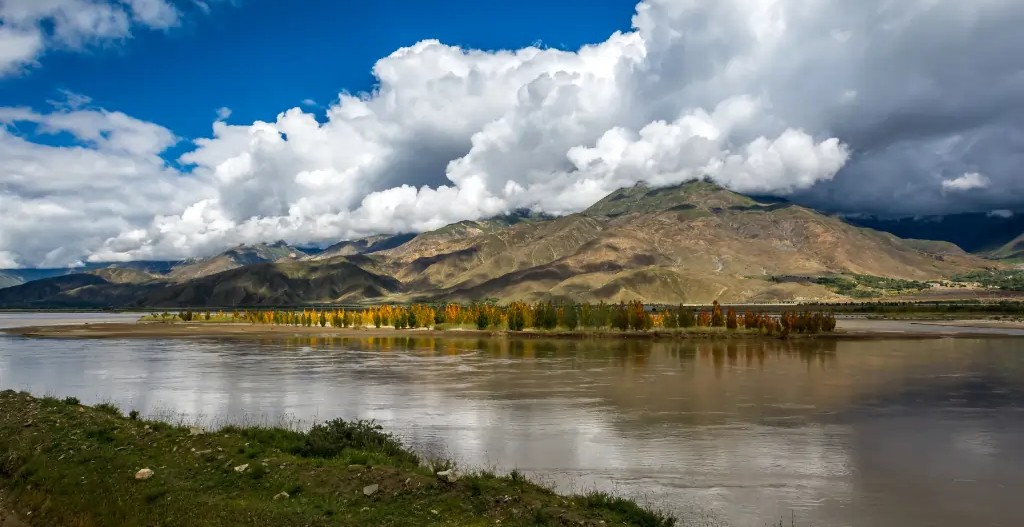
Brahmaputra River
In this guide
- The land that makes movement hard
- Not one culture, but many
- Where India meets Southeast Asia
- The Brahmaputra
- Assam, and how tea remade a valley
- Forests, rain and wildlife
- Living cultures, not disappearing ones
- Christianity, arriving differently everywhere
- Food most travellers have never tasted
- Weaving, textiles and craft
- Borders, and a complicated modern history
- There is no single Northeast India
- Travelling Northeast India
Most India guides run out of road somewhere around Kolkata. The Northeast — eight states connected to the rest of the country by a corridor of land barely twenty kilometres wide at its narrowest point — gets a paragraph, if it gets anything.
That’s a mistake, and not just because it leaves out some of the most striking landscapes in the country. It’s a mistake because the Northeast isn’t India’s far corner. It’s a crossroads — the place where the Indian subcontinent, the Himalayas, Tibet and Southeast Asia all physically run into each other, and have been trading, migrating and intermarrying across those lines for far longer than any modern border has existed.
Once you see it as a meeting point instead of an edge, everything else about the region — the sheer number of languages, the food that looks nothing like “Indian food,” the mix of religions — stops being confusing and starts being the point.
The land that makes movement hard
Start with the terrain, because it explains almost everything that follows. The Eastern Himalayas fold down into the region from the north, the Brahmaputra and Barak rivers cut broad valleys through otherwise mountainous terrain, and dense forest covers most of the slopes in between. Add one of the highest rainfall totals on Earth — parts of Meghalaya are among the wettest inhabited places in the world — and you get a landscape where a village twenty kilometres away, across a ridge, can be genuinely difficult to reach.
That difficulty of movement is not a footnote. It’s the reason this region ended up as dense with distinct cultures as it is.
Not one culture, but many
“Northeast India” is a geographic and political label, not a cultural one — and it’s worth being explicit about that before going any further, because it’s the single most common misunderstanding visitors arrive with.
The region is home to an extraordinary number of distinct ethnic communities, speaking languages from several different families — Tibeto-Burman languages across much of the hill states, Tai-Ahom heritage shaping Assamese history and identity, and Indo-Aryan languages in parts of the Brahmaputra valley. Religious practice varies just as widely: Christianity is the majority faith in several states, Hinduism and indigenous animist traditions remain strong in others, and Buddhism has deep roots in the Himalayan-facing districts. Food, clothing and social structure shift again from valley to valley.
Treat the region the way you’d treat Central Europe, not the way you’d treat a single country — because that’s closer to what it actually is.
Where India meets Southeast Asia
This is the defining idea for the whole region. Long before independence, long before colonial borders were drawn at all, this stretch of mountains and valleys connected — and still connects — to Tibet, Myanmar, Bhutan, Bangladesh and, through them, the wider world of Southeast Asia. Trade routes, migration and marriage moved through these hills in every direction for centuries.
That history shows up today in faces, food, festivals and family names that read as much Southeast Asian as South Asian — not because something odd happened here, but because the region was always part of that wider world, and the modern map simply drew a line through the middle of it.
Not India’s far corner — a crossroads.
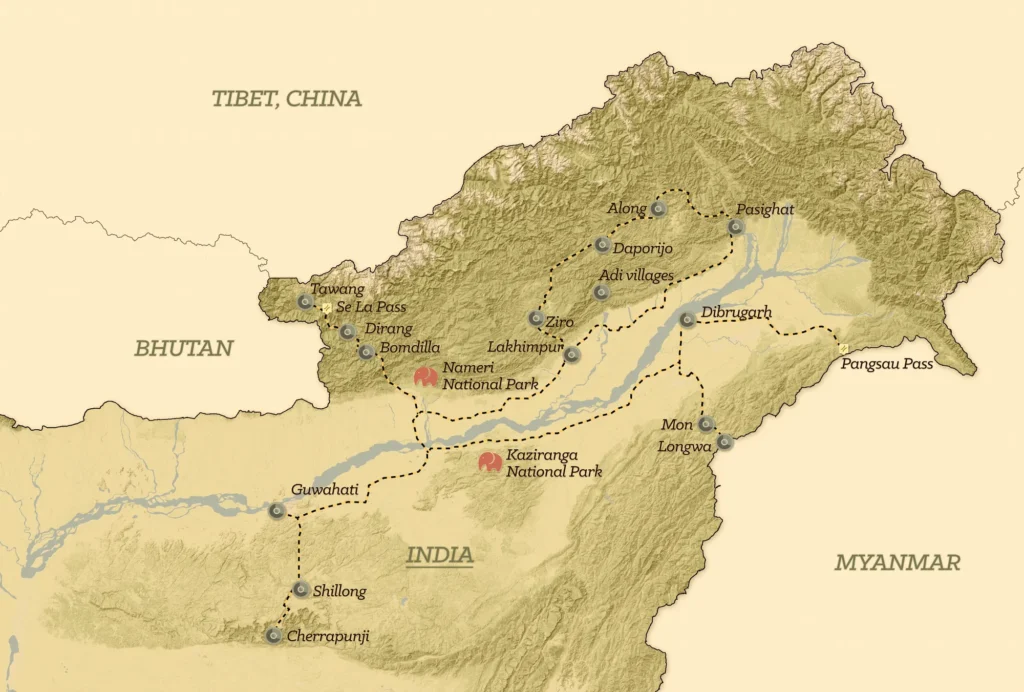
Brahmaputra River and neighboring countries
The Brahmaputra
If one river explains Assam, it’s this one. The Brahmaputra doesn’t just pass through the valley — it built it, laying down the floodplain that makes large-scale agriculture possible in a region that’s otherwise mostly mountain and forest.
Everything downstream of that fact follows: dense settlement along the river, a transport network built around boats and ferries as much as roads, an annual flood cycle that both destroys and renews farmland, and some of India’s richest wildlife habitat sustained by the wetlands the river leaves behind.
Assam, and how tea remade a valley
Assam’s other defining feature didn’t grow here on its own — it was planted.
British planters discovered in the nineteenth century that Assam’s climate and soil suited tea remarkably well, and built an industry around it that reshaped the valley: vast estates, purpose-built plantation towns, and large-scale labour migration from other parts of India that permanently changed the region’s demography. Today Assam supplies a meaningful share of the world’s tea, and the plantation landscape — bungalows, factories, workers’ settlements — is still one of the most visible layers of the valley’s history, sitting alongside the much older Ahom and indigenous Assamese culture it was built on top of.
Forests, rain and wildlife
Kaziranga’s rhinos, elephant herds moving between forest corridors, some of the richest biodiversity anywhere in Asia — none of it is an accident. It’s a direct product of the geography already described: heavy rainfall, river-fed wetlands, and forest cover largely undisturbed by the kind of dense agricultural settlement that reshaped much of the rest of India.
Worth remembering as you travel through it: conservation here isn’t happening in an empty landscape. Indigenous and local communities have lived alongside this wildlife for generations, and their land and livelihoods are as much a part of the conservation story as the animals are.
Living cultures, not disappearing ones
It’s tempting for outside guides to write about the region’s indigenous communities the way a museum writes a placard — traditional dress, traditional festivals, traditional crafts, past tense implied throughout. That framing does real damage, and it’s worth actively resisting.
Community structures, traditional agriculture, weaving, oral storytelling and festival calendars across the hill states aren’t relics being preserved. They’re ongoing, adapting, everyday parts of how people actually live now — practiced alongside smartphones and college degrees, not instead of them.
Living cultures, not disappearing cultures.
Christianity, arriving differently everywhere
Christianity is the majority religion across several Northeast states, and it’s tempting to compress that into a single sentence — “British missionaries brought Christianity here” — and move on. That’s true as far as it goes, but it flattens a much more varied story.
Missionary activity arrived at different times, through different denominations, and was received very differently from community to community — in some places reshaping education and social structures within a generation, in others integrating more gradually alongside existing indigenous belief. What’s consistent across the region is that Christianity today isn’t experienced as a foreign import. It’s a settled, central part of contemporary identity in the states where it took root, expressed through everything from church architecture to choral music to how festivals and Sundays are structured.
Food most travellers have never tasted
If you arrive expecting curry and naan, Northeast India’s food will genuinely surprise you — and that surprise is worth treating as one of the best reasons to visit, not a complication.
Rice is the staple rather than wheat. Pork and fish, often smoked, appear far more than in most of mainland Indian cooking. Fermentation runs through everything — fermented soybean, fermented bamboo shoot, fermented fish — used the way mainland India uses spice, as a foundational flavour rather than a garnish. Herbs grow wild and get used generously; bamboo shoot itself turns up in dozens of forms. Chillies, particularly Nagaland’s bhut jolokia, one of the hottest in the world, are used with real intent rather than restraint.
The wider point: “Indian food,” as most outsiders picture it, describes maybe a third of the country. This is what the rest of it can taste like.
🌿 A different wellness thread
The fermentation running through Northeast Indian food isn’t only about flavour — fermented and foraged foods here carry their own long tradition of herbal and dietary knowledge, distinct from mainland Ayurveda but built on the same basic idea: what you eat and how you prepare it is bound up with how you stay well. Worth knowing, rather than assuming every wellness thread in India traces back to the same source.
Weaving, textiles and craft
Few parts of India reward looking closely at cloth the way the Northeast does. Weaving traditions vary sharply by community — distinct motifs, techniques and natural materials that function as a genuine marker of identity, not decoration. A shawl’s pattern can indicate a specific community, sometimes a specific clan, and ceremonial textiles carry meaning well beyond how they look.
It’s a visual, hands-on way into the region’s diversity: spend time in a weaving village or a state handloom emporium and you’ll see, in cloth, the same variety the languages and food already told you was there.
Borders, and a complicated modern history
The Northeast’s modern shape can’t be understood without its borders. Partition in 1947 cut the region off from its most direct routes to the rest of India, leaving it connected to the mainland only through the narrow Siliguri Corridor. Today it shares international borders with Bangladesh, Myanmar, Bhutan and China — the last of these, particularly around Arunachal Pradesh, remaining a subject of longstanding territorial dispute between India and China.
The decades since independence have also seen significant internal change: large-scale migration that shifted the demographic balance in parts of the region, a series of political movements for greater autonomy or separate statehood, and, in some states, periods of insurgency and conflict that shaped both local politics and how the region was governed from Delhi. Much of this has settled considerably in recent decades through statehood, peace accords and political negotiation, though the underlying questions of identity, land and autonomy that drove it remain part of everyday political life in several states.
None of this needs to alarm a traveller today — the routes covered in this guide are visited safely and regularly. But it’s worth understanding as context, rather than discovering it secondhand from a permit form at the border.
There is no single Northeast India
Eight states, each with its own character — a brief map before you plan a route:
Assam
The Brahmaputra valley — tea estates, Kaziranga’s wildlife, Ahom history, and the region’s main transport hub.
Meghalaya
Living root bridges, some of the wettest places on Earth, and Khasi and Garo matrilineal traditions rare anywhere in India.
Nagaland
Sixteen recognised tribes, strong Christian identity, the Hornbill Festival, and some of the region’s most distinctive textiles and cuisine.
Manipur
Classical Manipuri dance, Loktak Lake’s floating islands, and a rich, still under-visited food and craft tradition.
Mizoram
Steep hill terrain, strong Christian and Mizo cultural identity, and some of the cleanest, most orderly small cities in India.
Tripura
Close to the Bangladesh border, layered Bengali and indigenous Tripuri culture, and striking royal-era palaces and temples.
Arunachal Pradesh
The most Himalayan and least visited state, Tibetan Buddhist monasteries, and permit-controlled travel that rewards real planning.
Sikkim
Technically Himalayan rather than Northeastern in some classifications, but usually paired with the region — Buddhist monasteries, high-altitude landscapes, and India’s most orderly tourism infrastructure outside the mainland.
And the wider series keeps its shape:
Rajasthan
Scarcity
South India
Sea & monsoon
Central India
Rivers & abundance
Northeast
Mountains & borders
Same question, same method, entirely different answer: mountains and difficult terrain didn’t just isolate this region — they preserved an extraordinary density of distinct cultures that flatter, easier terrain tends to blur together.
Travelling Northeast India
The practical layer, after all the context above:
- Permits. Foreign travellers need a Protected Area Permit for Arunachal Pradesh, and Restricted Area Permits still apply in parts of the region; Indian citizens need an Inner Line Permit for Arunachal Pradesh, Nagaland and Mizoram. Rules shift periodically — worth confirming current requirements before finalising a route rather than assuming last year’s rules still hold.
- When to go. October to April is the most reliable window, avoiding the heaviest monsoon rainfall; Meghalaya especially can become genuinely difficult to move through in peak monsoon months.
- Connectivity and roads. Distances that look short on a map often take far longer than expected on hill roads — build real slack into any itinerary rather than mainland-style daily targets.
- Getting around. Guwahati is the main air hub for the region; from there, road travel (and, in Assam, river transport) covers most onward routes.
- Cultural etiquette. Ask before photographing people, especially in smaller villages; dress and behaviour expectations vary noticeably between, say, a Naga village and a Guwahati city street.
- Festivals. Nagaland’s Hornbill Festival in December is the best-known, but Bihu in Assam, and dozens of smaller community festivals throughout the year, are often more rewarding for a traveller willing to plan around them.
- Homestays. Community-run homestays are widespread and, in several states, genuinely the best way to experience local life rather than a compromise on comfort.
- Wildlife. Kaziranga and Manas National Parks are the headline destinations, but book jeep and boat safaris well ahead in peak season.
More than anywhere else in this guide series, the Northeast rewards slower travel. Trying to cover too much ground here works against the place — fewer states, more time in each, is almost always the better trip.
Mountains didn’t isolate this region so much as fill it — with more cultures, languages and stories than almost anywhere else in India.
Thinking about a Northeast route — permits, a realistic pace across two or three states, or which festivals or homestays are actually worth building a trip around? Message me on WhatsApp.