India Guide — South India
Where the Sea Shaped the Land
South India isn’t the southern part of a country. It’s a peninsula that built its own civilisation around the sea, the monsoon and the Deccan — long before anyone arrived to “discover” it.
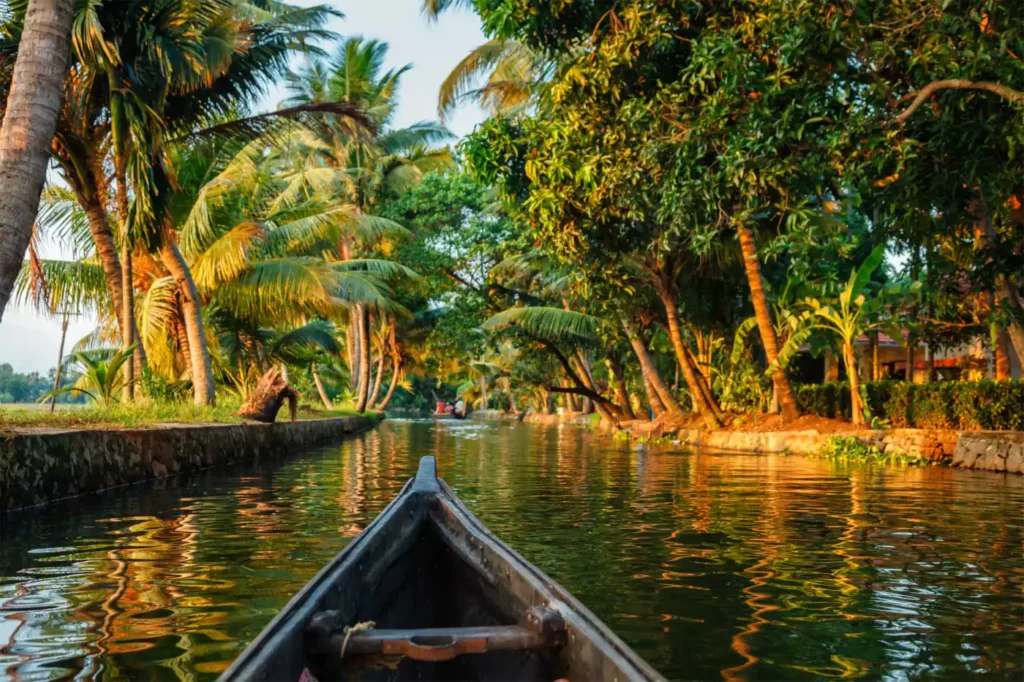
South India
In this guide
- The land before the label
- The sea was already a highway
- Europe arrives — the ocean was already busy
- Kingdoms, and what they left behind
- The temple as more than a place of worship
- A region, not a single culture
- Food, and the coconut question
- The coast and the fishing life
- What people wear, and why
- Dance, music and performance
- Belief, layered over centuries
- Modern South India
- There is no single South India
- Travelling South India
Most guides to South India begin with a list: temples, beaches, spices, coconut. All true, none of it explains anything.
The more useful starting point is a single idea: South India is a peninsula shaped by the sea, the monsoon, the Deccan, and some of India’s oldest continuously evolving cultural and linguistic traditions. Everything else in this guide — the food, the temples, the languages, the way people dress — is downstream of that one fact.
Once you see the land first, the rest stops feeling like a list of attractions and starts feeling like a story that’s still being told.
The land before the label
Don’t start with Tamil Nadu, Kerala, Karnataka, Andhra Pradesh or Telangana. Start with the land itself.
Peninsular South India is bordered by the Arabian Sea to the west, the Bay of Bengal to the east, and the Indian Ocean to the south — a landmass with water on three sides. Running down each coast are the Western and Eastern Ghats, two mountain ranges that frame a raised interior tableland: the Deccan Plateau. Between the Ghats and the sea sit narrow, fertile coastal plains; inland, the Deccan is drier, harder, older rock.
Over all of it, every year, arrives the monsoon — first the southwest monsoon breaking against the Western Ghats and drenching Kerala and coastal Karnataka, then the northeast monsoon later in the year bringing rain to the Tamil Nadu coast. The two coasts don’t even get wet at the same time.
That’s the same shape of argument as a desert building trade caravans or a river plain building an empire — geography sets the conditions, culture is what people build in response. The monsoon here doesn’t just water crops. It sets the rhythm of rice cultivation, plantation farming, fishing seasons, temple festival calendars, and even how buildings are designed — deep eaves, sloped roofs, verandas built to survive water that outsiders would call relentless and locals would call ordinary.
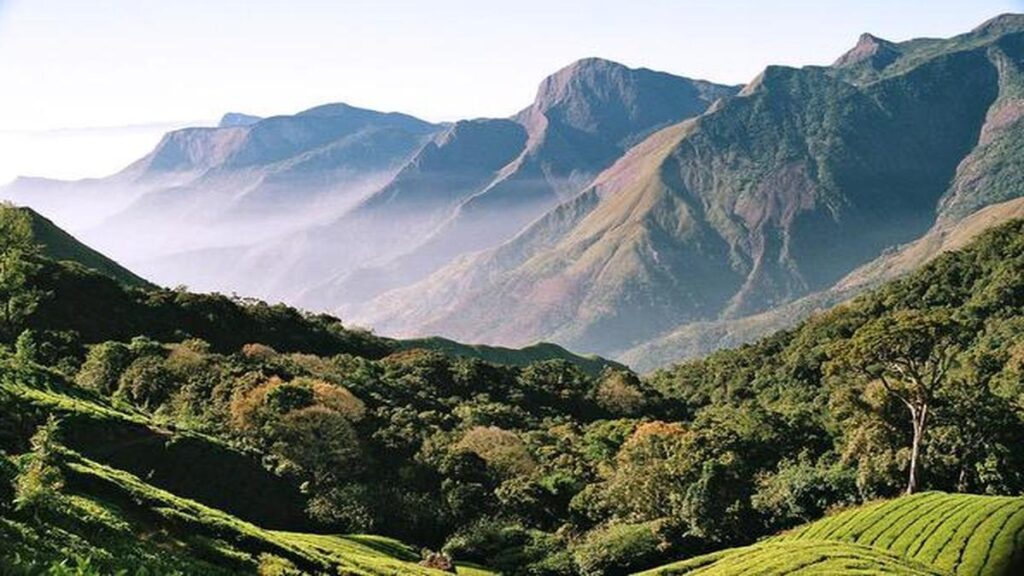
Western Ghats
The sea was already a highway
This is where South India starts to feel considerably more sophisticated than the postcard version.
Long before any European ship rounded the Cape of Good Hope, the Indian Ocean was already a functioning commercial world — Arab, Persian, East African, Southeast Asian and Chinese traders moving along monsoon wind patterns that had been understood and used for centuries. South Indian ports weren’t waiting to be found. They were already nodes in a network stretching from the Red Sea to the Malay Archipelago.
Pepper, cardamom, cinnamon and other spices moved out through these ports. So did textiles, rice, timber, coir and sandalwood. Historical evidence points to these coastal trading towns as genuinely cosmopolitan places — multiple languages spoken in the same market, multiple religious communities settled in the same town, centuries before “globalisation” became a word anyone needed.
Guide’s note
This is the single most important reframe for understanding South Indian history: the story isn’t “Europeans discovered South India.” It’s “Europeans arrived in a maritime trading world that was already old, sophisticated and deeply interconnected.”
Europe arrives — the ocean was already busy
Vasco da Gama’s arrival on the Kerala coast in the late fifteenth century is usually taught as a beginning. It’s better understood as an interruption — a new, well-armed participant entering a trading system that had functioned without it for a very long time.
The Portuguese wanted control of the spice trade, and Goa became the centre of their presence — a legacy still visible today in its churches, architecture and Catholic heritage. The Dutch followed, then the English and the French, each competing for footholds along the coast: Kochi, Chennai (Madras), Pondicherry, and smaller ports like Masulipatnam and Pulicat. The English East India Company’s presence around forts like Fort St George grew into something far larger than a trading post — eventually the political centre from which British rule expanded across the subcontinent. Pondicherry, meanwhile, stayed French in flavour and administration long enough that its street grid, architecture and even some of its bureaucratic habits still read differently from the rest of Tamil Nadu.
It’s worth resisting the temptation to let this four-century competition dominate the story, though — because South Indian history is much older and considerably richer than the period of European trading posts.
Kingdoms, and what they left behind
Long before Goa or Pondicherry, the peninsula was shaped by dynasties whose names are less familiar abroad but whose fingerprints are everywhere a traveller looks: the Cholas, Pandyas, Cheras and Pallavas in the Tamil south; the Chalukyas and later the Hoysalas in the Karnataka interior; and, spanning much of the peninsula at its height, the Vijayanagara Empire, ruling from a capital whose ruins now sit at Hampi.
The useful question isn’t which dynasty ruled when. It’s: what did these kingdoms leave behind that you can still see today?
The answer, overwhelmingly, is architecture — and specifically, temples.
What did these kingdoms leave behind that a traveller can still see?
The temple as more than a place of worship
A South Indian temple is not simply a building where people pray. Historically, it was closer to an institution — economic, social, artistic and political all at once. Temples owned land, employed dancers and musicians, funded irrigation, hosted markets, and anchored entire towns around their festival calendars.
This is why Dravidian temple architecture looks the way it does: soaring gopurams (gateway towers) announcing the temple from a distance, wide temple tanks for ritual bathing, pillared mandapas for gathering, and, in the case of temple towns like Madurai or Srirangam, a temple so large it effectively is the town, with the city built in concentric rings around it.
A few places do the most work for understanding this: Thanjavur’s Brihadeeswarar Temple for Chola engineering and ambition; Madurai’s Meenakshi Amman Temple for the sheer scale of a living temple town; Mahabalipuram for rock-cut shrines carved directly from the coastline’s granite; and Hampi and Belur/Halebidu for what happens when an empire pours its wealth into stone.
Look closer
Notice the gopuram before you notice anything else — its height and decoration were historically a visible statement of the dynasty’s wealth and reach, readable from across the town centuries before anyone needed a map.
A region, not a single culture
It’s tempting, especially for a first-time visitor, to think of “South India” the way one might think of “Bavaria” or “Provence” — a single culture with regional variation at the edges. That’s not quite right.
Tamil, Telugu, Kannada and Malayalam aren’t dialects of one southern language. They belong to the Dravidian language family and each carries its own distinct literary tradition, cinema, and centuries of history — Tamil in particular has one of the world’s oldest continuously used literary traditions, stretching back over two thousand years through the Sangam corpus. Language here isn’t just communication. It’s identity, and it’s one of the main reasons South India eventually reorganised itself into states along linguistic lines rather than old administrative boundaries.
The message worth carrying with you: South India is a region, not a single culture. What’s true in Kerala is often not true two states over.
A question visitors sometimes ask
Why do people in southern India often have darker skin than in the north? The honest answer is more interesting than a single-line explanation: skin pigmentation varies considerably across individuals and populations everywhere in India, and reflects a mix of ancestry, population history and long-term adaptation to UV exposure — populations closer to the equator, with more year-round sun, tend toward greater pigmentation for protection, a pattern seen worldwide and not unique to South Asia.
There’s no single “South Indian skin colour” any more than there’s a single South Indian culture — the variation within the south is considerable too.
Food, and the coconut question
“Why is there coconut everywhere?” is a fair question, and the brochure answer — “it grows here” — is true but incomplete.
What follows from that chain, though, is not one cuisine — it’s a family of cuisines, shaped as much by ecology and trade as by taste. Kerala’s food leans into coconut milk, seafood and the spices that made the state famous on Indian Ocean trade routes. Tamil Nadu’s cooking runs on rice, lentils, tamarind and a formal structure of meals — the thali, the dosa, the filter coffee ritual. Karnataka’s cuisine bridges the coast and the Deccan interior, from Mangalorean seafood to Mysore’s vegetarian traditions. Andhra and Telangana are, region for region, among the spiciest food traditions in the country, built around rice, chillies and a biryani tradition shaped by Deccan sultanate courts.
None of it is arbitrary. Every dish is a fairly direct answer to “what does this coastline, this climate, this trade route make possible?”
🌿 A wellness thread
Many of the spices that once moved through these Indian Ocean trade routes — turmeric, ginger, black pepper, cardamom — aren’t only prized for flavour. They also carry long histories in Ayurveda, India’s traditional system of health, which treats food and wellbeing as closely connected rather than separate concerns. It’s one more layer sitting quietly underneath the cuisine, and it comes up again later, in Kerala.
The coast and the fishing life
Step away from the temple towns and the Deccan interior, and South India’s other defining rhythm is coastal: fishing communities strung along both the Arabian Sea and Bay of Bengal coasts, their working days still set by monsoon and tide rather than a calendar. Kerala’s backwaters and Karnataka’s and Tamil Nadu’s fishing harbours run on this older logic — boats, nets, seafood markets at dawn, and a relationship with the sea that long predates any trade empire.
It’s a useful contrast to hold in mind as you move through the region: interior South India built kingdoms and temples; coastal South India built ports, boats and trade. Both are equally “South India.”
What people wear, and why
Clothing here follows the same logic as everything else — climate and culture, not decoration for its own sake. The classic South Indian sari is typically woven from lighter fabrics suited to heat and humidity, in traditions specific enough that a Kanjeevaram silk from Tamil Nadu and a Kerala kasavu sari with its gold border are instantly distinguishable to a local eye, and worn in different contexts. Men’s traditional dress — the veshti or dhoti in Tamil Nadu, the mundu in Kerala — is built around the same heat-and-humidity logic, cotton wrapped rather than tailored.
What varies by region, occasion and profession here is worth noticing rather than flattening into “what South Indians wear.”
Dance, music and performance
South India’s classical performing arts — Bharatanatyam, Kathakali, Kuchipudi, Mohiniyattam, Yakshagana, and the Carnatic music tradition that underpins several of them — didn’t appear as folk curiosities. They grew out of temples and royal courts, built to tell devotional stories, often over the course of a single night’s performance.
Bharatanatyam developed inside Tamil temple traditions before its twentieth-century revival as a stage art. Kathakali, with its elaborate face paint and costume, developed in Kerala as a way of staging entire Hindu epics through gesture and expression. Carnatic music, South India’s classical tradition, still structures its repertoire around devotional compositions written centuries ago.
The theme repeats: culture here grows out of history, not from nowhere.
Belief, layered over centuries
South India’s religious landscape is often assumed to be uniformly Hindu, and that assumption undersells it. Hindu traditions here run deep and varied — Shaivism, Vaishnavism, Bhakti devotionalism — but sit alongside some of India’s oldest Jain communities, and, particularly on the Kerala coast, some of the oldest Christian and Jewish communities anywhere in Asia.
Kerala’s Syrian Christian tradition traces its own origins back through the same Indian Ocean trade networks discussed earlier — long before Portuguese missionaries arrived and layered Catholic influence on top of communities that already existed. Kerala also once held small, historic Jewish communities in towns like Kochi, connected to the same maritime world. It’s a much better story than “Kerala has Christians” — it’s “the sea brought belief here the same way it brought spices and language.”
Modern South India
The story doesn’t stop in the temple-building or colonial-trading eras. British India organised much of the region as the Madras Presidency, alongside princely states like Mysore, Travancore and Hyderabad that retained significant autonomy until independence. After 1947, the linguistic reorganisation of Indian states in the 1950s and 60s carved out Tamil Nadu, Kerala, Karnataka and (eventually, in 2014) Telangana as separate from Andhra Pradesh — largely along the language lines discussed earlier.
Contemporary South India is also where a great deal of modern India runs from: Bengaluru’s technology industry, Chennai’s manufacturing and film industry, Hyderabad’s pharmaceutical and IT sectors, and a set of education systems that consistently rank among the country’s strongest. The old story — geography, trade, kingdoms, temples — is still visible underneath all of it, if you know where to look.
There is no single South India
Everything above applies unevenly across five very different places. A short map before you plan anything:
Kerala
Sea, monsoon, backwaters, spices, Christianity, maritime history — and the modern home of Ayurveda, where the tradition mentioned earlier in the food section becomes something you can actually experience, not just read about.
Tamil Nadu
Tamil identity and one of the world’s oldest living literary traditions, Chola-era temple towns, classical arts, and a long eastern coastline shaped by centuries of trade.
Karnataka
Deccan plateau meets the coast — Hampi’s ruined empire, Mysore’s palaces, Bengaluru’s modern tech economy, and a coffee-growing interior few visitors expect.
Andhra Pradesh & Telangana
Deccan sultanate architecture, Telugu culture, major river systems, Hyderabad’s layered Nizami and modern identity, and some of the country’s spiciest food.
Goa
The clearest single place to see the Portuguese encounter up close — Catholic heritage, Konkan culture, and four centuries of European maritime history layered onto an Indian coastline.
🌿 On Kerala and Ayurveda
Ayurveda isn’t a spa treatment invented for tourists — it’s a much older Indian system of medicine and daily life, and Kerala developed a particularly strong, continuous tradition of it. Modern wellness tourism is simply one contemporary expression of something considerably deeper. If it’s the kind of thing you’d want to build a few extra days around — a genuine stay rather than a one-afternoon treatment — it’s worth mentioning when we plan the route.
Travelling South India
The practical layer, after all the context above:
- Timing and the monsoon. The two coasts get wet at different times of year — Kerala’s monsoon runs roughly June to September, Tamil Nadu’s northeast monsoon arrives later, October to December. Plan around whichever coast you’re prioritising.
- How long to spend. South India rewards slowness more than the north’s big-ticket circuit does. Two weeks lets you combine two or three states properly rather than rushing five.
- Good combinations. Kerala backwaters + Tamil temple towns; Karnataka’s Hampi + Mysore + Bengaluru; a coastal Kerala-and-Goa run for contrasting colonial histories side by side.
- Temple etiquette. Shoes off before entering, modest dress expected regardless of heat, and some inner sanctums are closed to non-Hindus — worth checking ahead rather than being turned away.
- Backwaters and beaches. A houseboat on Kerala’s backwaters is worth a full day, not a rushed afternoon. Beaches vary hugely in character between Goa, Kerala and the Tamil coast.
- Food expectations. Expect meals to change completely from state to state — don’t assume “South Indian food” means one thing once you’re actually there.
- Festivals. Temple festivals can transform a town’s traffic and rhythm for days; if your dates overlap with one, it’s usually worth staying rather than working around it.
None of this needs memorising before you land. It just helps to know it’s coming.
The sea, the monsoon and the temples explain the shape of South India. The route through it is still yours to build.
Planning an actual trip through South India — or curious whether a few days built around Kerala’s Ayurveda tradition, a backwater stay or a particular temple town makes sense for your route? Message me on WhatsApp.