India Guide · South India · Deep Dive
Andhra Pradesh and Telangana: The Deccan East
Two rivers cross the same dry plateau as Karnataka’s, but end somewhere very different — a fertile coast, a diamond-trading fort, and a language of poets.
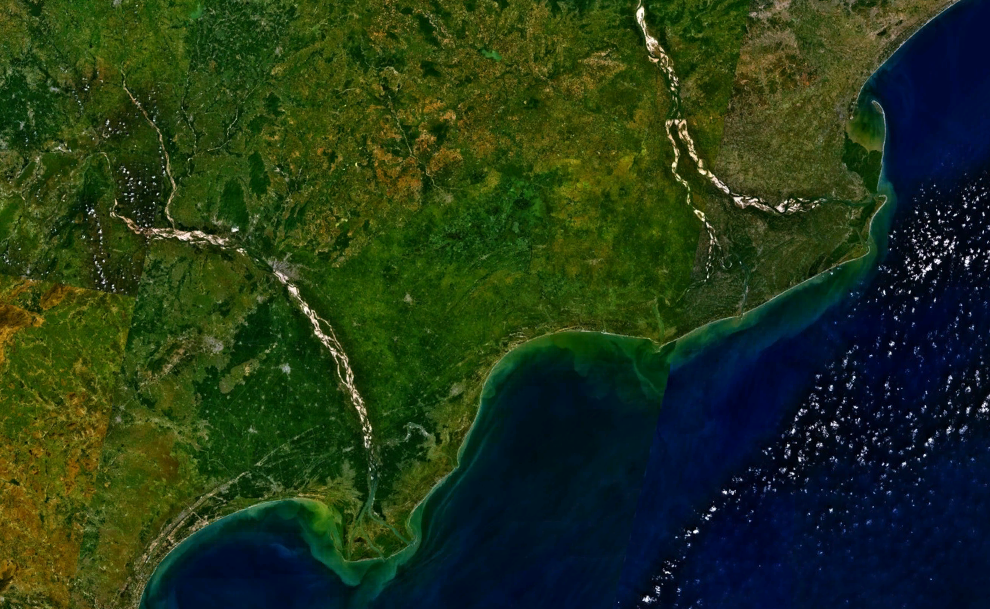
Krishna Godavari Delta
In this guide
- Where the Deccan meets the Bay of Bengal
- The Satavahanas and the Buddhist coast
- The Kakatiyas and the dry plateau’s engineering
- Between empire and sultanate
- Golconda’s diamonds and the founding of Hyderabad
- Telugu: a language of poets
- Kuchipudi and the arts of the Deccan east
- Fire, biryani and the Deccan table
- Modern Andhra and Telangana
- Travelling the Deccan east
Karnataka’s guide closed by looking east across the plateau. This one picks up exactly there — Andhra Pradesh and Telangana, the Telugu-speaking Deccan east, where two great rivers cross much of the same dry plateau geology before reaching a coastline entirely unlike Karnataka’s own.
This guide follows the same principle as every deep dive before it: geography first, culture as the consequence.
Where the Deccan meets the Bay of Bengal
Telugu-speaking territory spans two modern states — Telangana, occupying the interior Deccan plateau around Hyderabad, and Andhra Pradesh, running along the Bay of Bengal coast and down into the drier Rayalaseema region to the south. Both states share a language, much of a history, and, until 2014, a single administrative existence — but their geography has always pulled in two directions at once.
Two rivers, one shared destiny
The Krishna and Godavari rivers both rise far to the west, cross the entire breadth of the Deccan plateau, and empty into the Bay of Bengal through some of India’s most fertile river deltas — a pattern similar to Tamil Nadu’s Kaveri, but on a considerably larger scale, crossing much greater distances of dry plateau before reaching the coast.
Rayalaseema: the driest corner
South and west of the deltas, Rayalaseema is drier still, historically prone to famine and reliant on tank irrigation systems this guide returns to shortly — a reminder that even within a state whose identity leans coastal, water scarcity has shaped entire regional identities just a short distance inland.
The Satavahanas and the Buddhist coast
Long before the Kakatiyas or the Qutb Shahis, the Satavahana dynasty, ruling much of the Deccan from roughly the 2nd century BCE to the 2nd century CE, built one of the region’s first major kingdoms — and, notably, one of its most significant centres of Buddhist patronage.
Amaravati and the coastal trade routes
Under Satavahana patronage, the great stupa at Amaravati, on the banks of the Krishna, grew into one of the most important Buddhist sites in India, its elaborately carved limestone panels developing into what art historians call the Amaravati school of sculpture — an influential style whose visual language spread through trade contact to Buddhist communities across Southeast Asia. Nearby, the site of Nagarjunakonda, once a major monastic university complex, was partly submerged by a modern dam in the 20th century, though its remaining structures and finds were relocated and preserved.
A coast that exported more than goods
Just as Odisha’s ports carried Buddhist influence across the Bay of Bengal after Ashoka’s conquest of Kalinga, this stretch of the Andhra coast — through Amaravati’s sculptural tradition and its trading ports — helped carry Buddhist art and ideas outward across the same maritime world, centuries before either the Cholas or the Vijayanagara Empire existed.
The wealth behind this patronage came from the same source as everything else in this guide: fertile deltas, agricultural surplus, and control of trade routes running between the interior plateau and a genuinely international coastline.
The Kakatiyas and the dry plateau’s engineering
Centuries later, the Kakatiya dynasty, ruling Telangana’s interior plateau from their capital at Warangal roughly between the 12th and 14th centuries, faced a very different geographic problem from the coastal Satavahanas: how to farm reliably on a dry plateau with no delta to speak of.
An empire of tanks
Their answer was one of medieval India’s most extensive irrigation-tank systems — thousands of artificial reservoirs built across Telangana’s plateau to capture and store monsoon rainfall for use through the dry months, many of which remained in active use for irrigation well into the modern era. It’s a genuinely different engineering answer to the same underlying problem Tamil Nadu’s Chola-era Kallanai dam and Kerala’s Kuttanad bunds each solved in their own way: how do you make a landscape reliably farmable when nature doesn’t cooperate on its own?
Warangal’s temples
The Kakatiyas also left a distinctive architectural legacy at Warangal, including the Thousand Pillar Temple and the striking Kakatiya Kala Thoranam, an ornately carved stone arch that has since become one of the enduring symbols of Telangana identity, appearing on the state’s official emblem today.
Between empire and sultanate
After the Kakatiyas fell to the Delhi Sultanate’s expanding armies in the 14th century, this region spent the following centuries caught between two very different kinds of power.
For a period, the Vijayanagara Empire, already described in detail in this guide’s Karnataka chapter, extended its influence into Rayalaseema and parts of coastal Andhra, briefly drawing the region into the same imperial orbit as Hampi. But as Vijayanagara’s power receded following its defeat at the Battle of Talikota in 1565, the interior plateau came instead under the control of the Deccan Sultanates — a set of Muslim-ruled successor states to an earlier Bahmani kingdom, of which one, the Qutb Shahi dynasty based at Golconda, would go on to shape the region’s future more than any other.
Golconda’s diamonds and the founding of Hyderabad
Golconda Fort, on the outskirts of what’s now Hyderabad, became the Qutb Shahi capital — and the centre of one of the most significant diamond-trading operations in world history.
The mines behind the myth
The diamond mines near Golconda, at Kollur and elsewhere along the Krishna river, produced some of the most famous stones ever recorded, reportedly including the Kohinoor and the stone that eventually became known as the Hope Diamond — Golconda’s name became so closely associated with exceptional diamonds that it entered the English language as shorthand for a source of great wealth, independent of the specific fort’s own later fortunes.
A name that outlived the fort
“Golconda” is still used in English today, generations after the fort itself lost its diamond-trading importance, to describe any rich, seemingly inexhaustible source of wealth — a rare case of a South Indian place name becoming a common noun in a language spoken half a world away.
Founding Hyderabad
In 1591, the Qutb Shahi ruler Muhammad Quli Qutb Shah founded a new city just east of the fort, building the Charminar — a monumental four-arched, four-minaret structure — as its symbolic centrepiece, and Hyderabad grew from there into one of the Deccan’s most significant cities.
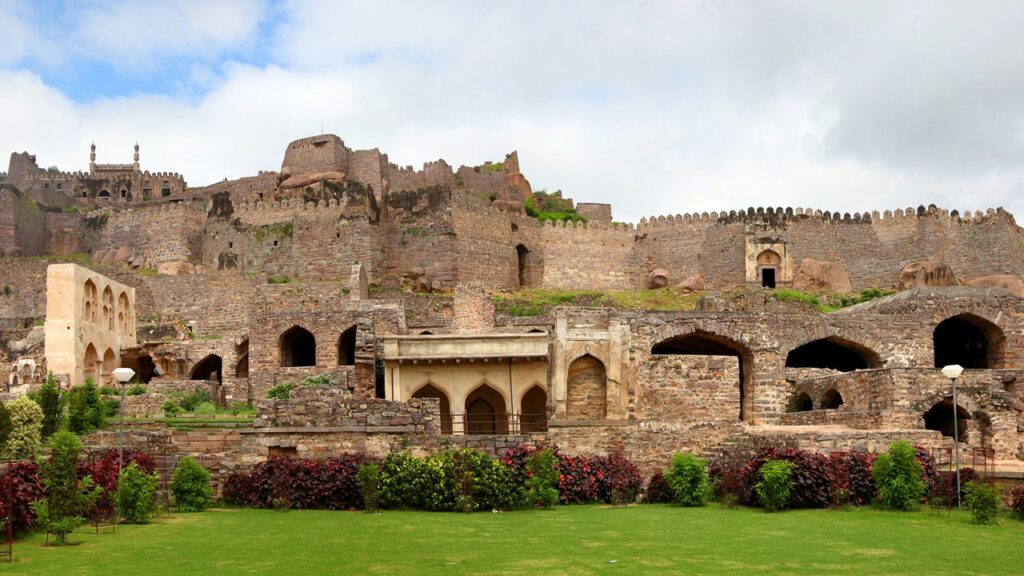
Golconda Fort
The Nizams
After Mughal conquest ended Qutb Shahi rule in the late 17th century, a Mughal-appointed governor eventually broke away to found his own dynasty, the Asaf Jahi Nizams, who ruled Hyderabad State as one of British India’s largest and wealthiest princely states right up until 1948, when it acceded to the newly independent Indian union. The Nizam-era city — its bazaars, palaces and Persian-influenced court culture — still shapes Hyderabad’s character today, layered on top of the earlier Qutb Shahi foundations.
Telugu: a language of poets
Telugu, like Tamil and Kannada, is officially recognised as a classical language of India, with a literary tradition stretching back well over a thousand years — often described, for the melodic, vowel-rich quality of its sound, as among the most lyrical of India’s major languages.
A rich tradition of devotional and courtly poetry developed under successive Deccan dynasties, and Telugu’s status as one of the most widely spoken languages in India today, alongside a prolific modern literary and cinematic output, keeps that centuries-old poetic reputation genuinely alive rather than confined to the past.
Kuchipudi and the arts of the Deccan east
Just as Tamil Nadu has Bharatanatyam and Kerala has Mohiniyattam, the Deccan east has its own classical dance tradition: Kuchipudi, named after the village in coastal Andhra where it developed.
Traditionally performed as dance-drama rather than solo recital, Kuchipudi was historically danced entirely by Brahmin men, including in female roles, before opening more broadly to performers of all backgrounds in the 20th century. Like its classical cousins further south, it draws on temple and devotional storytelling traditions, though its dance-drama structure and distinctive footwork give it a noticeably different character from Bharatanatyam’s more solo, sculptural vocabulary.
Carnatic music, shared broadly across South India, also has a substantial Telugu-language tradition of its own, with several of the classical repertoire’s most significant composers writing devotional works in Telugu alongside Tamil and Sanskrit.
Fire, biryani and the Deccan table
Andhra cuisine has a well-earned reputation as among the spiciest in India, closely tied to Guntur, a district famous for producing some of the country’s most potent chilli varieties. Dishes like gongura (a tart, leafy green cooked into a distinctive pickle-like relish) and pulihora (tamarind rice) showcase a cuisine built around bold, sour and fiery flavours rather than the gentler profiles found in much of Kerala or Tamil Nadu’s cooking.
Hyderabad’s food tells a different, equally distinct story: Hyderabadi biryani, cooked in the dum style — meat and rice layered and sealed to slow-cook together — developed under Nizami court kitchens as a genuine fusion of Mughlai and Deccan culinary traditions, and remains one of India’s most recognisable regional biryanis. The city’s Irani cafés, serving sweet milky tea (Irani chai) alongside Osmania biscuits, are a smaller but equally distinctive legacy of Hyderabad’s Persian-influenced court culture, still a genuine part of the city’s daily rhythm today.
Modern Andhra and Telangana
In 2014, after decades of regional political movement centred on Telangana’s demand for separate statehood, the Indian parliament passed the Andhra Pradesh Reorganisation Act, splitting the existing state of Andhra Pradesh into two: Telangana, and a smaller, reconstituted Andhra Pradesh.
Sharing, then separating, a capital
Hyderabad, geographically located within Telangana’s new borders, initially served as a joint capital for both states for a defined transitional period before becoming Telangana’s sole capital. Andhra Pradesh has since been developing Amaravati, near Vijayawada in the Krishna delta, as its new capital — a genuinely rare instance of a modern Indian state building an entirely new capital city largely from scratch.
Cyberabad
Hyderabad’s own economic story runs in close parallel to Bengaluru’s: from the 1990s onward, dedicated IT and technology zones — HITEC City among them, informally giving rise to the nickname “Cyberabad” — transformed the city into one of India’s most significant technology and pharmaceutical hubs, adding a thoroughly modern layer on top of Qutb Shahi forts, Nizami palaces and Kakatiya-era temples within the same metropolitan area.
A diamond fort, a Nizam’s court, and a technology park — Hyderabad has been reinventing its own wealth for four hundred years.
Travelling the Deccan east
Practical notes
- Season. November to February is by far the most comfortable window; summers across the plateau and coast alike bring serious heat.
- Tirupati draws enormous crowds year-round given its religious significance — plan for queues and, if possible, look into the temple’s various pilgrim-registration options in advance.
- Hyderabadi biryani is worth seeking out from an established, dedicated biryani restaurant rather than a general menu item — the dum-cooking method genuinely changes the dish.
- Hyderabad and Warangal pair naturally as a single trip, given the direct historical line from Kakatiya Warangal to Qutb Shahi Golconda.
That completes the four-state South India deep dive — Kerala, Tamil Nadu, Karnataka and the Deccan east, each shaped by the same peninsula in a different way.
Curious about Golconda, Hyderabad’s food, or the Deccan east firsthand? Message me on WhatsApp.