India Guide · Regions
Rajasthan: How the Desert Shaped a Culture
In a land where water was never guaranteed, everything else had to earn its place.
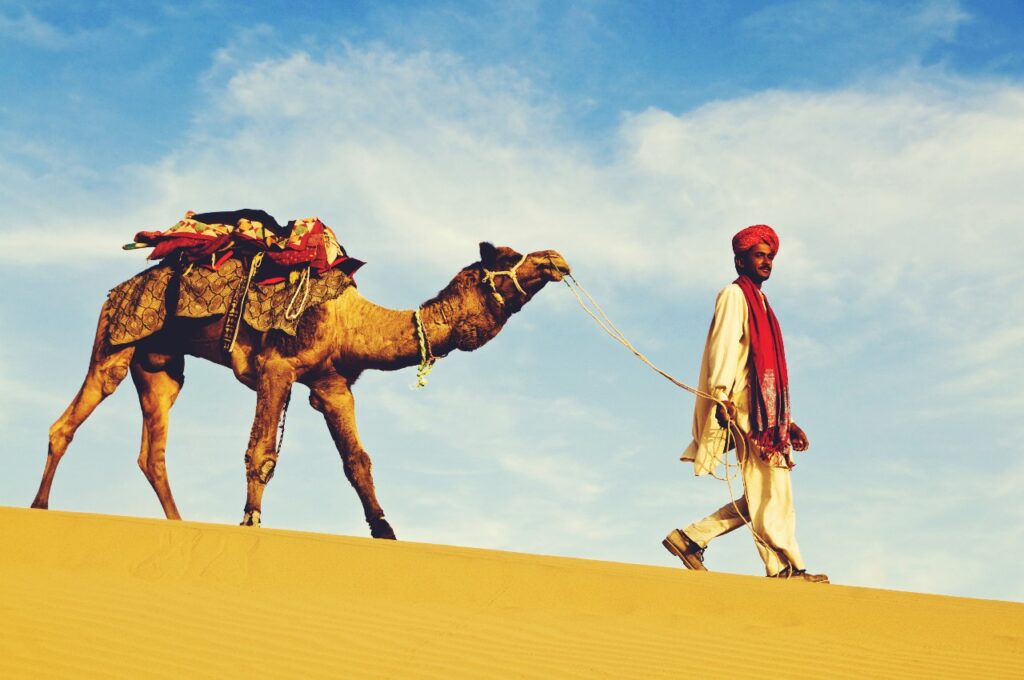
Camel in Jaisalmer
Most guidebooks introduce Rajasthan through its palaces. I’d rather start with the reason those palaces look the way they do — the desert that sits underneath everything else in this state, quietly explaining it.
Rajasthan is India’s largest state by area and one of its driest, dominated by the Thar Desert in the west and increasingly fertile land as you move east. That single geographic fact — an enormous, arid landscape where water could never be taken for granted — shaped almost everything that followed: where people settled, what they built, what they ate, what they wore, and even how their kingdoms rose to power.
Understand that, and Rajasthan stops being a list of forts and starts being a story.
The desert that defines everything
The Thar is one of the most densely populated deserts in the world, which surprises people who imagine deserts as empty. It isn’t empty here — it’s simply a landscape that never let anyone forget the cost of water.
Rainfall across most of Rajasthan is sparse and unreliable, concentrated into a short monsoon window that can fail entirely in a bad year. Temperatures swing brutally between a scorching summer and a genuinely cold desert winter. Settlement in a landscape like this isn’t a matter of choosing the prettiest spot — it’s a matter of choosing the spot near water, and then building an entire civilisation around protecting and extending that resource.
Living with scarcity
Rajasthan’s relationship with water produced some of its most distinctive architecture, long before a single palace was built for show.
Stepwells — deep, terraced structures descending sometimes ten or more storeys below ground — were built across the region not as decoration but as engineering: a way to reach groundwater as it dropped through the dry season, and a rare source of shade and cool air in a landscape that offered neither. Rainwater harvesting tanks, communal wells and elaborate channel systems appear again and again across Rajasthani towns, each one a direct answer to the same question: how do you keep a community alive through a season that might not bring rain at all?
Not just architecture
Stepwells look ornamental to modern eyes, but they were built out of necessity, not aesthetics. The carving and scale came later, once a structure people depended on for survival also became something they took pride in.
Trade across the desert
A hostile landscape isn’t automatically a poor one — and Rajasthan’s location turned out to be one of its greatest assets. Sitting between the ports of Gujarat and the trading routes of North India and Central Asia, Rajasthan became a corridor that caravans had to cross, and the merchant communities who controlled that crossing became extraordinarily wealthy.
Camel caravans carried textiles, spices, opium, salt and other goods across the desert for centuries, and the cities that grew up along these routes — Jaisalmer especially — thrived as staging posts. Marwari merchant families built commercial networks that would eventually extend across India and beyond, and their wealth flowed directly back into the region in the form of art, architecture and civic buildings.
The forts and havelis
Rajasthan’s forts weren’t built for beauty, even though they’ve become some of the most photographed buildings in the world. They were built as direct responses to three pressures at once: geography, defence and wealth.
Hilltop positioning made a fort harder to besiege and easier to defend with fewer soldiers. Thick walls and narrow approaches turned the desert’s exposure into an advantage. And once a kingdom had wealth from trade and agriculture, that wealth showed up as increasingly elaborate palaces built inside the fortifications — mirror work, carved sandstone screens, painted courtyards — a display of prosperity that could still be defended if it needed to be.
Havelis, the ornate merchant mansions found across towns like Jaisalmer and Bikaner, tell a related but different story: private wealth built by trading families, competing with each other through architecture in the same way modern businesses might compete through advertising.
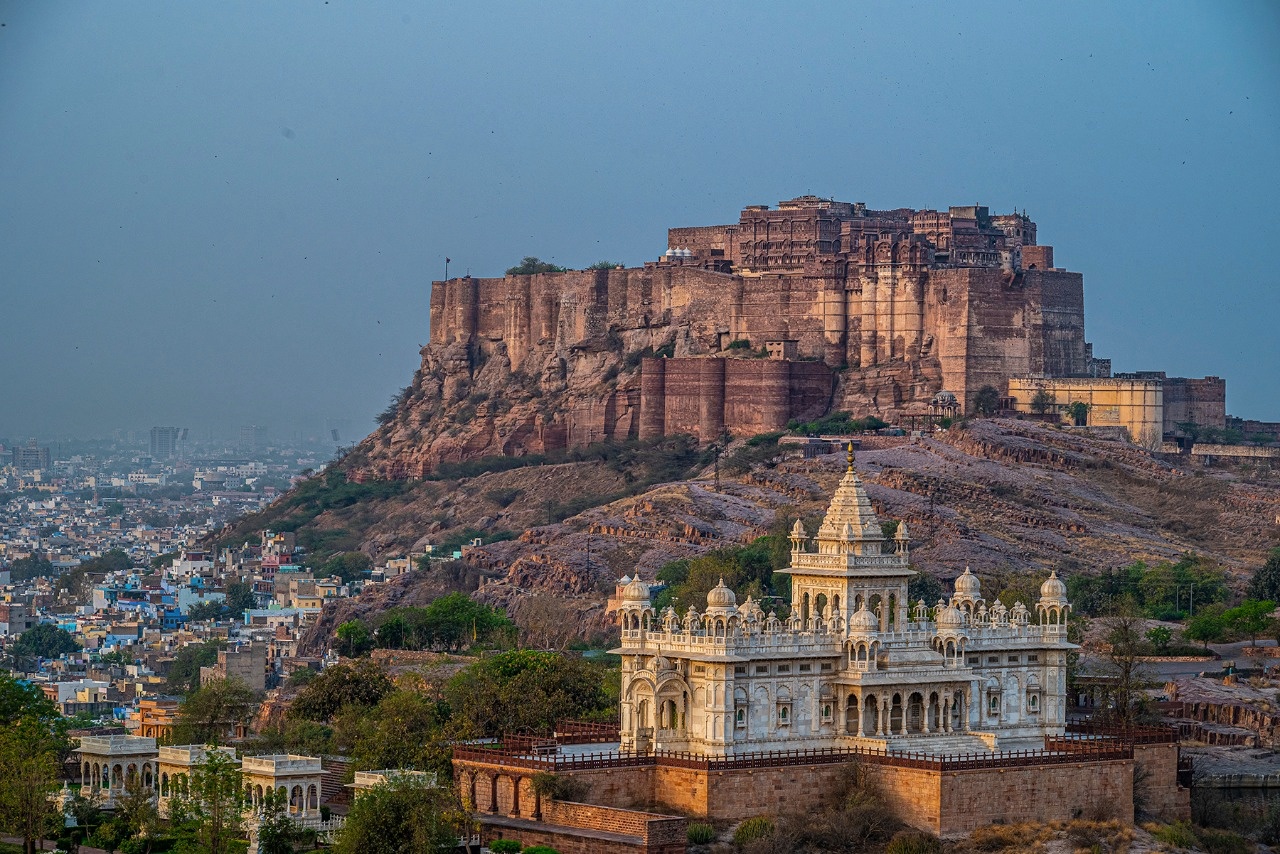
Mehrangarh Fort Jodhpur
The forts weren’t built for beauty. Beauty is just what wealth and defence looked like, together.
What people ate
Rajasthani cuisine developed under exactly the constraints you’d expect from an arid region: limited fresh water, limited fresh vegetables for much of the year, and a real need for food that could survive storage through long dry seasons.
The result is a cuisine built heavily around lentils, gram flour, dried beans and preserved vegetables, often cooked in ghee rather than water-heavy sauces — a practical adaptation as much as a flavour choice. Dairy plays a large role, since livestock could survive conditions crops couldn’t. Some of the region’s best-known dishes exist specifically because they were designed to travel or store well, a legacy of a landscape where you couldn’t always assume fresh ingredients would be available tomorrow.
It’s a cuisine shaped by scarcity that became, over generations, something people are genuinely proud of rather than merely tolerate.
What people wore
Clothing in Rajasthan answers the same two questions as everything else here: how do you survive this climate, and how do you signal who you are in a landscape without much else to distinguish one community from another?
Loose-fitting garments — the dhoti, flowing skirts, wrapped fabrics — suit extreme heat far better than fitted clothing. Turbans serve a genuinely practical purpose in a desert climate, protecting the head from sun and, when needed, doubling as a scarf against blowing sand. But turbans also became something more: a visual language.
Why the turbans have so many colours
A turban’s colour, size and tying style traditionally signalled region, community, caste and sometimes occasion — a wedding turban looks different from an everyday one. What looks purely decorative to a visitor is often, underneath, a form of identification that locals can read instantly.
The vivid colour palette Rajasthani textiles are known for — bright against the muted browns and golds of the desert — isn’t accidental either. Against a landscape this monochrome, colour itself became a form of expression and a marker of festivity.
Rajputs and Rajputana
Before it was called Rajasthan, this region was known as Rajputana — the land of the Rajputs, a network of warrior clans who ruled much of the region through a long history of shifting kingdoms, alliances and conflict.
Rajput identity was built around a code of honour, martial tradition and lineage, and the many kingdoms they ruled — Mewar, Marwar, Amber and others — spent centuries in complex relationships with each other and, later, with the Mughal Empire, sometimes through warfare and sometimes through alliance and marriage. That history is why Rajasthan’s map still reads like a patchwork of former kingdoms rather than a single administrative block, and why so many of its forts and palaces carry the name of a specific ruling family rather than just a city.
After independence, these princely states were integrated into the Indian union, but the cultural identity — the pride in lineage, the emphasis on honour and hospitality, the visual language of Rajput heritage — remains a visible part of how the region understands itself.
The cities
Each major city in Rajasthan grew for a different reason, and each still carries the personality of why it was founded.
Jaipur
The Pink City — a planned 18th-century capital, laid out on a grid centuries before that was common practice, built on wealth from trade and gems.
Jodhpur
The Blue City, dominated by the imposing Mehrangarh Fort — a frontier stronghold at the edge of the desert.
Udaipur
Built around artificial lakes — itself a striking response to scarcity, engineering abundance where none existed naturally.
Jaisalmer
The Golden City, deep in the Thar and still partly inhabited inside its sandstone fort — once the desert’s most important trading post.
Bikaner
A merchant city known for elaborate havelis and camel breeding, its wealth built on the caravan trade routes it once controlled.
Pushkar
A pilgrimage town built around a sacred lake, and home to one of India’s most famous camel fairs.
Rajasthan today
Modern Rajasthan is still shaped by the same underlying constraint that shaped its history: water. Large-scale irrigation projects have transformed agriculture in parts of the state, tourism has become a major economic force built directly on the region’s history and architecture, and the old merchant instinct that built the trading cities now shows up in business communities that remain influential well beyond the state’s borders.
The forts and havelis that were once purely functional are now among India’s most visited heritage sites — many converted into hotels, allowing visitors to sleep inside the same walls that were built to keep a kingdom’s wealth safe.
Travelling through Rajasthan
- Season matters enormously. Winter (October–March) is comfortable and the standard travel season; summer heat is genuinely extreme and best avoided.
- Distances are large. Rajasthan is India’s biggest state — plan for real travel time between cities rather than treating it like a compact circuit.
- Heritage hotels — converted forts, havelis and palaces — are one of the most distinctive ways to experience the region’s architecture from the inside.
- Desert experiences — camel treks, overnight desert camps — are genuinely worthwhile here, not just tourist theatre, given how central the desert is to the region’s whole story.
- Bargaining is very much expected in the bazaars, especially for textiles, jewellery and leather goods.
- Modest dress is appreciated at forts, temples and in smaller towns, regardless of the heat.
- Trains and private drivers both work well; trains connect the major cities, while a private driver gives more flexibility for smaller towns along the way.
Next in the India Guide: South India, where the sea shaped the land instead of the desert.
Thinking about a real trip through Rajasthan, and want someone who explains the “why” as much as the “where”? Message me on WhatsApp.