India Guide · South India · Deep Dive
Tamil Nadu: The Land of Temple Cities
Kerala’s story was written by the sea. Tamil Nadu’s was written by rivers, and by an institution that turned agricultural wealth into some of the most ambitious architecture the subcontinent has ever produced.
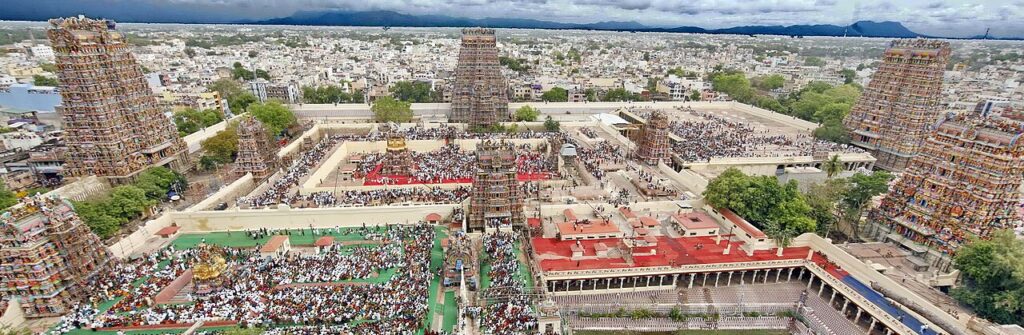
Meenakshi Amman Temple
In this guide
- The peninsula between plateau and bay
- The rivers that built kingdoms
- Why entire cities grew around temples
- Pallavas, Cholas and Pandyas
- The Nayaks and the second flowering
- Dravidian temple architecture
- Bronze, stone and the sculptor’s craft
- Tamil: a language with a very long memory
- Where the peninsula meets the Bay of Bengal
- The Western Ghats and the Nilgiris
- Classical arts, rooted in the temple
- Rice, temple kitchens and Chettinad heat
- Chettinad: mansions built on trade
- Modern Tamil Nadu: language, cinema and the coast
- Travelling Tamil Nadu
Kerala’s story was written by the Arabian Sea and the Western Ghats. Tamil Nadu’s is written somewhere else entirely — by rivers flowing east into the Bay of Bengal, and by an institution, the temple, that turned agricultural wealth into some of the most ambitious architecture and art the subcontinent has ever produced.
This guide follows the same principle as Kerala’s: geography first, culture as the consequence. The story here just runs through very different terrain — and, as it turns out, through nearly as much of it.
The peninsula between plateau and bay
Tamil Nadu occupies the southeastern tip of the Indian peninsula, bounded by the Eastern Ghats and the Deccan plateau to the north and west, the Western Ghats and Kerala along its southwestern edge, and the Bay of Bengal along virtually its entire eastern coastline, down to Kanyakumari at India’s southern tip, where the Bay of Bengal, the Arabian Sea and the wider Indian Ocean meet.
Between the plateau and the coast, several substantial rivers cross the state, and one above all others has shaped its history: the Kaveri, rising in Karnataka’s Western Ghats and flowing east across Tamil Nadu to form one of South India’s most fertile river deltas before reaching the sea near Thanjavur.
A dry interior, a wet delta
Away from the river deltas, much of Tamil Nadu’s interior is considerably drier than Kerala’s saturated landscape just across the Western Ghats — the mountains block much of the southwest monsoon from reaching this side, so Tamil Nadu depends more heavily on the northeast monsoon, arriving later in the year between October and December, and on the river systems carrying water in from elsewhere. That contrast, dry plateau against wet river delta, explains a great deal about where population, agriculture and, eventually, kingdoms concentrated.
The rivers that built kingdoms
The Kaveri delta, sometimes called the rice bowl of Tamil Nadu, is the most fertile stretch of land in the state, and it isn’t a coincidence that this exact region became the heartland of the Chola dynasty, one of the most powerful and longest-lived kingdoms in Indian history.
Reliable water meant reliable harvests. Reliable harvests meant a taxable surplus large enough to fund armies, administrators, and — crucially for what follows — extraordinarily ambitious temple-building projects. Other rivers, the Vaigai around Madurai and the Tamiraparani in the far south, produced smaller but similarly important pockets of fertile, densely settled land, each eventually becoming the base of its own ruling dynasty: the Pandyas around Madurai, and various regional powers further south.
Irrigation as an ancient technology
Tamil kingdoms invested heavily in irrigation infrastructure centuries before anyone used that word for it. The Kallanai, or Grand Anicut, a dam across the Kaveri built under the Chola king Karikala around the 2nd century CE, is among the oldest water-regulation structures still in active use anywhere in the world — still directing water into the delta’s irrigation channels today, nearly two thousand years after it was built.
Why entire cities grew around temples
It’s easy to see a great South Indian temple and assume it was simply a place of worship, built by a wealthy king as an act of devotion. That’s true as far as it goes, but it understates what a major Tamil temple actually was — and, in many cases, still is.
The temple as economic institution
A large temple complex functioned as a landholder, controlling substantial agricultural estates whose income supported its operations. It functioned as an employer, providing work for priests, administrators, cooks, garland-makers, musicians, dancers, stone carvers and dozens of other specialised roles. In some periods it functioned as something close to a bank, holding endowments and circulating resources within the local economy. And it functioned as the single largest patron of the arts in the region — any sculptor, musician or dancer with serious ambitions needed a relationship with a major temple to practise their craft at the highest level.
The temple as social centre
Festivals organised around the temple calendar drew merchants, entertainers and pilgrims from far beyond the immediate area, effectively functioning as the region’s major trade fairs and social gatherings rolled into one event. A temple town wasn’t built near a temple the way a modern town might be built near a factory. The temple was usually the reason the town existed at all — the economic engine an entire settlement grew around.
The temple was never simply a religious institution. It was the economic engine an entire town grew around.
Pallavas, Cholas and Pandyas
The Pallavas and the birth of a style
Long before the Cholas reached their peak, the Pallava dynasty, ruling from the 6th to 9th centuries CE, pioneered much of what would become recognisably Dravidian temple architecture at their port town of Mahabalipuram. Rather than building temples from cut stone alone, Pallava sculptors carved entire monolithic temples — the famous Pancha Rathas — directly out of single granite boulders, alongside the shore-facing Shore Temple that still stands, weathered by centuries of sea spray, as one of the earliest structural stone temples in South India.
The Cholas: an empire built on rice and temples
The Chola dynasty, reaching its height between the 9th and 13th centuries, took everything the Pallavas had started and scaled it to an imperial level. Rajaraja Chola I, ruling around the turn of the 11th century, built the Brihadeeswarar Temple at Thanjavur as a direct architectural statement of imperial power — a subject this guide returns to in more detail shortly. His son Rajendra Chola I extended the empire further still, founding an entirely new capital, Gangaikonda Cholapuram, and launching one of the most ambitious naval campaigns in pre-modern Indian history, described later in this guide.
Village democracy under the Cholas
Chola administration extended well beyond temple-building and taxation. At Uttiramerur, inscriptions carved into temple walls around the 10th century describe an astonishingly detailed system of local self-governance: villages electing councils through a process involving palm-leaf ballots drawn from a pot, strict qualification and disqualification criteria for candidates, fixed terms of office, and specific committees responsible for irrigation, finance and other local matters. It’s one of the earliest and most detailed records of organised local self-government found anywhere in the ancient world, and a reminder that Chola sophistication extended well past architecture and conquest into genuinely elaborate civic administration.
The Pandyas and Madurai
To the south, the Pandya dynasty ruled from Madurai for much of this same broad period, and by tradition sponsored the ancient Sangam literary academies discussed later in this guide. The temple most associated with Madurai today, the vast Meenakshi Amman Temple, sits on a site with roots stretching back to Pandya-era worship, though — as the next chapter explains — much of the structure actually visible today dates to a considerably later period.
The Nayaks and the second flowering
Pallava, Chola and Pandya foundations explain most of the temple sites you’ll encounter across Tamil Nadu. But if a gopuram looks painted in vivid colour, covered floor-to-ceiling in sculpted figures, or if a temple complex includes a vast thousand-pillar hall, there’s a good chance you’re looking at work from several centuries later, layered on top of a much older core.
After the Chola and Pandya empires declined, the Vijayanagara Empire, based far to the north in what’s now Karnataka, extended its authority over much of Tamil Nadu from the 14th century onward, ruling through regional governors known as Nayaks. When Vijayanagara itself eventually fell in the 16th century, several of these Nayak families, in Madurai, Thanjavur and Gingee, became independent rulers in their own right — and it’s this period, roughly the 16th and 17th centuries, that produced much of what visitors actually associate with South Indian temple grandeur today.
Madurai’s second act
The Meenakshi Amman Temple’s soaring, intricately painted gopurams and its famous Thousand Pillar Hall date almost entirely to Nayak patronage under rulers like Tirumala Nayak in the 17th century, built on top of a much older Pandya-era temple core. The same is true across many of Tamil Nadu’s grandest temple complexes: the ancient sanctum might be Chola or Pandya, but the scale and spectacle a visitor actually experiences walking in today is very often Nayak.
Thanjavur’s second flowering
Thanjavur itself, having been the Chola capital centuries earlier, later became a Nayak and then Maratha capital in turn — the Thanjavur Maratha court, ruling from the 17th to 19th centuries, brought yet another cultural layer, patronising Carnatic music, painting and the distinctive gold-leaf Tanjore painting style still produced in the city today.
Dravidian temple architecture
Walk into a major Tamil temple and the architecture itself tells the same story as the history. Towering gopuram gateway towers, layered with sculpted figures and often visible from kilometres away, mark the entrance. A stepped, pyramidal vimana rises over the temple’s central sanctum. Wide, pillared mandapam halls provide space for ritual, performance and gathering. And a temple tank — a large, stepped water reservoir — sits nearby for ritual bathing, itself another small expression of the region’s ongoing relationship with water management.
Brihadeeswarar Temple: a case study
The Brihadeeswarar Temple in Thanjavur, completed under Rajaraja Chola I around 1010 CE, remains one of the most complete expressions of this architectural language. Its vimana rises to roughly 66 metres, capped by a single carved granite block weighing an estimated 80 tonnes — reportedly hauled up a specially built ramp nearly 6.5 kilometres long, an engineering feat historians still debate the exact method of today. It’s now a UNESCO World Heritage Site, alongside the later Chola temples at Gangaikonda Cholapuram and Darasuram that extended the same architectural tradition.
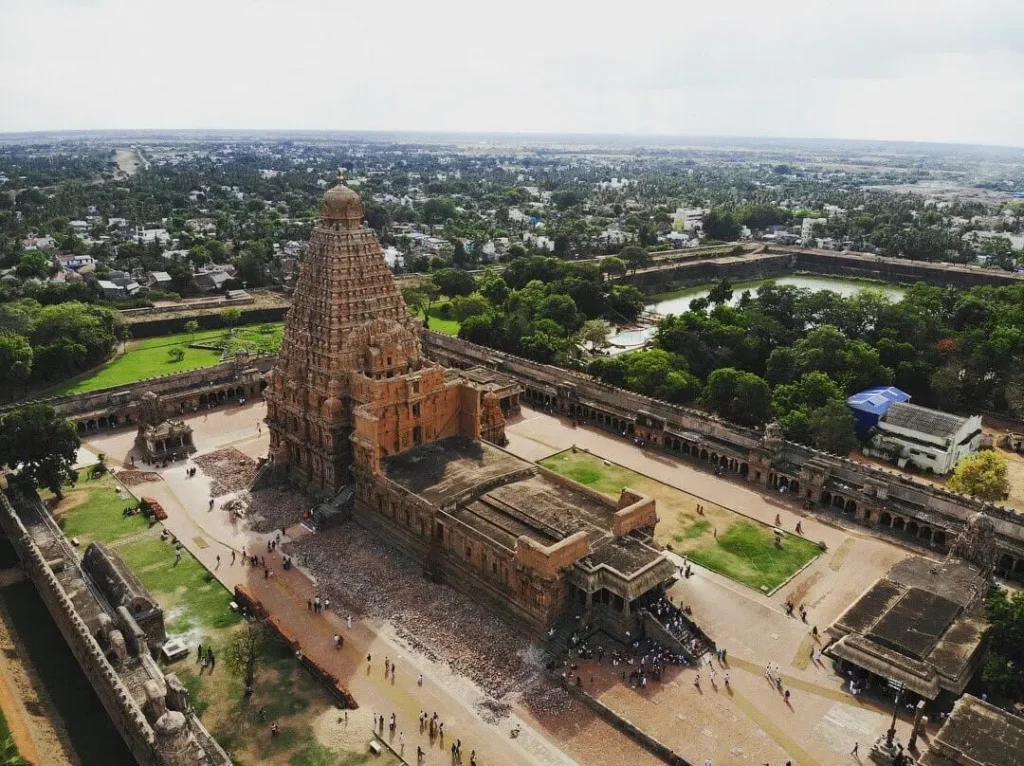
Photo — Brihadeeswarar Templ
Bronze, stone and the sculptor’s craft
Temple patronage didn’t just fund architecture. It funded an entire sculptural tradition, in both stone and bronze, that remains one of Tamil Nadu’s most significant artistic legacies.
Chola bronzes
Among the most celebrated achievements of Chola-era art are its bronze temple icons, cast using the lost-wax method: a wax model is built, encased in clay, then melted out and replaced with molten bronze, meaning every finished bronze is technically unique, cast from a mould destroyed in the process. The most famous subject is Nataraja, Shiva as the cosmic dancer, depicted mid-motion within a ring of fire — an image so refined in its balance of movement and stillness that it’s often held up as one of the great achievements of world sculpture, not just Indian art. These bronzes weren’t museum pieces in their own time; they were, and in many working temples still are, processional deities, carried out of the sanctum and paraded through the streets during festivals.
A mould used once
Every lost-wax bronze is destroyed in the making of the next — the clay mould is broken to release the finished piece, meaning no two bronzes, however similar, are ever truly identical. It’s a craft built around a kind of deliberate impermanence most manufacturing traditions try to eliminate.
A living craft
Unlike many historical art forms that survive only in museums, lost-wax bronze casting is still practised today, most famously in the town of Swamimalai, where hereditary sculptor families continue producing bronzes using techniques passed down largely unchanged since the Chola period.
Stone carving
Stone sculpture developed alongside bronze casting, visible in the elaborate figures covering nearly every surface of a major gopuram or mandapam — deities, mythological narrative scenes, dancers, musicians and guardian figures, carved directly into the temple structure rather than added afterward. Mahabalipuram, already discussed for its Pallava-era rock-cut monuments, remains a working stone-carving centre today, its workshops still training sculptors in techniques with direct roots in that seventh-century tradition.
Tamil: a language with a very long memory
Tamil is one of the world’s few classical languages with an unbroken literary tradition stretching back more than two thousand years, still spoken and written by tens of millions of people today rather than surviving only in scripture or scholarship.
Sangam literature
The earliest surviving body of Tamil poetry, known as Sangam literature, is traditionally associated with a series of ancient literary academies said to have been patronised by Pandya kings, and dates back roughly two thousand years — remarkably secular in subject matter for its age, covering love, war, ethics and everyday life rather than religious devotion alone. Later devotional poetry, the Tevaram and Tirumurai hymns of the Bhakti movement, layered a different tradition on top, tying Tamil literary identity closely to Shaiva and Vaishnava temple worship in the centuries that followed.
A language you can still read
Educated Tamil speakers today can, with some effort, still engage directly with Sangam-era poetry nearly two millennia old — a genuinely rare continuity that few of the world’s languages, classical or modern, can claim.
Language as identity
Tamil’s status isn’t just literary pride — it’s deeply tied to modern Tamil political identity, a thread this guide returns to in the chapter on modern Tamil Nadu.
Where the peninsula meets the Bay of Bengal
Tamil Nadu’s second major geographic force runs along its coast rather than its rivers. The Bay of Bengal connected this coastline to Sri Lanka, Southeast Asia and, through wider trading networks, to China — and for a period under the Chola dynasty, that connection became a genuine maritime empire.
When a kingdom looked outward
Rajendra Chola I, ruling in the early 11th century, launched a remarkable naval expedition across the Bay of Bengal against the Srivijaya kingdom based in Sumatra, projecting Tamil political and cultural influence deep into maritime Southeast Asia. It remains a rare instance of a South Asian power extending military reach that far by sea, and is still studied today as one of the most ambitious naval campaigns in pre-modern Indian history.
Tamil Nadu and Sri Lanka
Tamil Nadu’s coastal history connects it closely to Sri Lanka, just across the narrow Palk Strait — Chola kings campaigned there repeatedly, and cultural, linguistic and religious ties between Tamil Nadu and Sri Lanka’s Tamil-speaking population run deep and old, well before any modern political dimension existed. Rameswaram, at the very tip of the state, sits closest to Sri Lanka geographically and carries deep pilgrimage significance in Hindu tradition connected to the Ramayana.
Sri Lanka’s more recent history, including the decades-long civil conflict between the Sri Lankan government and Tamil separatist groups that ended in 2009, remains a sensitive and still-evolving subject for many Tamils on both sides of the strait, and deserves its own careful, current treatment rather than a brief mention in a travel guide. What’s worth knowing as a traveller is simply that the connection between Tamil Nadu and Sri Lankan Tamil communities is old, deep and still actively felt — not a distant historical footnote.
The 2004 tsunami
More recently, the Indian Ocean tsunami of December 2004 struck Tamil Nadu’s coastline hard, particularly around Nagapattinam and other fishing communities, killing thousands and reshaping coastal infrastructure and disaster preparedness across the state in the years since. It’s a reminder that this coastline’s relationship with the sea — the same sea that built Chola trade wealth and carried European colonial powers ashore — has never been purely benign.
European traders and Pondicherry
Centuries after the Cholas, the same coastline drew a familiar sequence of European trading powers — Portuguese, then Dutch, then French and British — each competing for access to Tamil ports and the textile trade the region was known for. The French held on longest at Pondicherry, which remained a French colonial enclave until 1954, seven years after Indian independence — a small but genuine piece of French colonial history still visible today in the town’s street grid, architecture and even its cuisine, distinct from anything else on this coast.
The Western Ghats and the Nilgiris
Tamil Nadu shares the Western Ghats’ biodiversity with Kerala along its western border, though the two states experience the range from different sides and, often, in different ways.
The Nilgiri Biosphere Reserve
The Nilgiri Hills, where Tamil Nadu, Kerala and Karnataka meet, form the core of the Nilgiri Biosphere Reserve, one of India’s largest protected areas and among the richest in biodiversity anywhere in the country. Mudumalai and Anamalai Tiger Reserves protect substantial elephant and tiger populations, and the entire region functions as a critical wildlife corridor — elephants in particular range across state boundaries here in ways that ignore the political map entirely.
One mountain range, two very different states
The Western Ghats don’t stop at a state border, and neither does the wildlife that depends on them — elephant corridors connecting Tamil Nadu’s Nilgiris to Kerala’s own reserves are a reminder that this guide’s state-by-state structure describes political geography more than ecological reality.
Tea, coffee and the cool hills
The same altitude and rainfall that supports this biodiversity also supports the hill-station plantation economy discussed later in this guide — Ooty and Kodaikanal’s tea gardens sit inside or alongside this same ecological zone, meaning a single trip into the Nilgiris can move between plantation landscape and genuine wilderness within a short distance, much as Kerala’s highlands do just across the border.
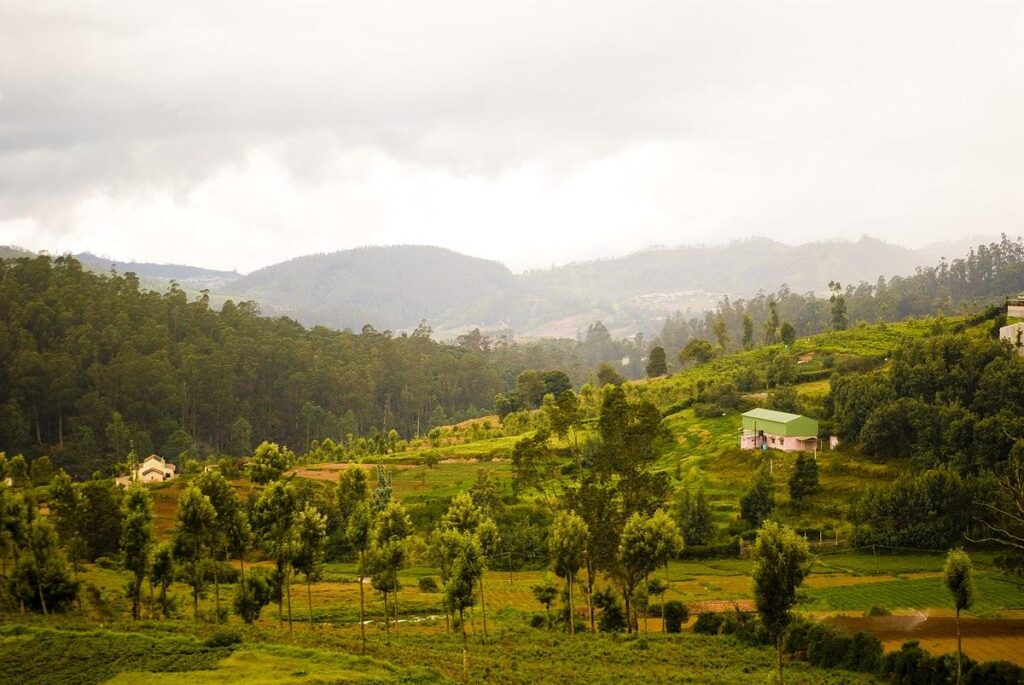
Photo — Nilgiri hills
Classical arts, rooted in the temple
Bharatanatyam
Bharatanatyam originated as a temple art form, performed by devadasis — women dedicated to temple service — as part of ritual worship, before undergoing a deliberate revival and codification into its modern classical form in the early 20th century. It draws heavily on the ancient Natya Shastra treatise on performing arts, telling stories through a codified vocabulary of hand gestures (mudras), facial expression and rhythm, performed in close relationship with Carnatic music.
Carnatic music
South India’s classical music tradition developed alongside, and largely in service of, temple devotion — composers like Tyagaraja produced enormous bodies of devotional work still performed today, in Tamil, Telugu and Sanskrit. Carnatic music remains genuinely central to contemporary Tamil cultural life, most visibly during Chennai’s December “music season,” when hundreds of concerts and dance performances run across the city over several weeks — one of the largest annual gatherings of classical Indian arts anywhere.
The festival calendar
Temple festivals remain the setting where these art forms are still most authentically experienced. Madurai’s Chithirai festival, held each April and May, re-enacts the celestial marriage of Meenakshi and Shiva through processions drawing enormous crowds across the city. Elsewhere, temple car festivals — enormous wooden chariots carrying processional deities, hauled through the streets by hundreds of devotees pulling on thick ropes — turn a single day into the entire town’s central social event, a direct, still-living continuation of exactly the temple-as-social-centre pattern described earlier in this guide.
Rice, temple kitchens and Chettinad heat
Tamil food, like Kerala’s, is built on a rice foundation, but the flavours and traditions that developed around it are distinctly different. Sambar and rasam anchor most Tamil meals, and dishes now eaten across India and well beyond — idli, dosa and vada among them — have strong roots in Tamil and broader South Indian kitchens, their exact origins still gently debated among food historians across several South Indian states.
Breakfast as its own tradition
Tamil breakfast culture is substantial enough to be considered its own culinary category: idli (steamed rice-and-lentil cakes), dosa (a fermented rice-and-lentil crepe, in dozens of regional variations), and vada (a savoury fried lentil doughnut) form a daily rotation eaten at home and in the countless small “mess” restaurants and roadside stalls found in every Tamil town, usually alongside sambar, coconut chutney and a strong cup of filter coffee.
The temple kitchen tradition
Temple kitchens shaped food culture here as directly as they shaped architecture and art: large-scale communal vegetarian cooking, offered as prasadam and then shared among devotees, is one of the oldest continuous food traditions in the region, and the discipline and scale of temple cooking influenced home cooking well beyond temple walls.
The banana leaf meal
A traditional Tamil “meals” is served on a banana leaf, with rice at the centre and small portions of vegetables, sambar, rasam, curd and pickle arranged around it in a specific order, refilled continuously by servers as the meal progresses. Eating with the right hand only, folding the leaf a particular way at the end to signal satisfaction, and the sheer rhythm of a proper meals service are all part of an etiquette most visitors pick up quickly simply by watching the table next to them.
Chettinad cuisine, from the Chettiar trading community discussed in more detail shortly, stands apart for its heavy, distinctive use of spices — a reflection, in its own way, of a trading community with connections reaching well beyond the region, layered on top of the same rice-and-lentil foundation as everywhere else in the state.
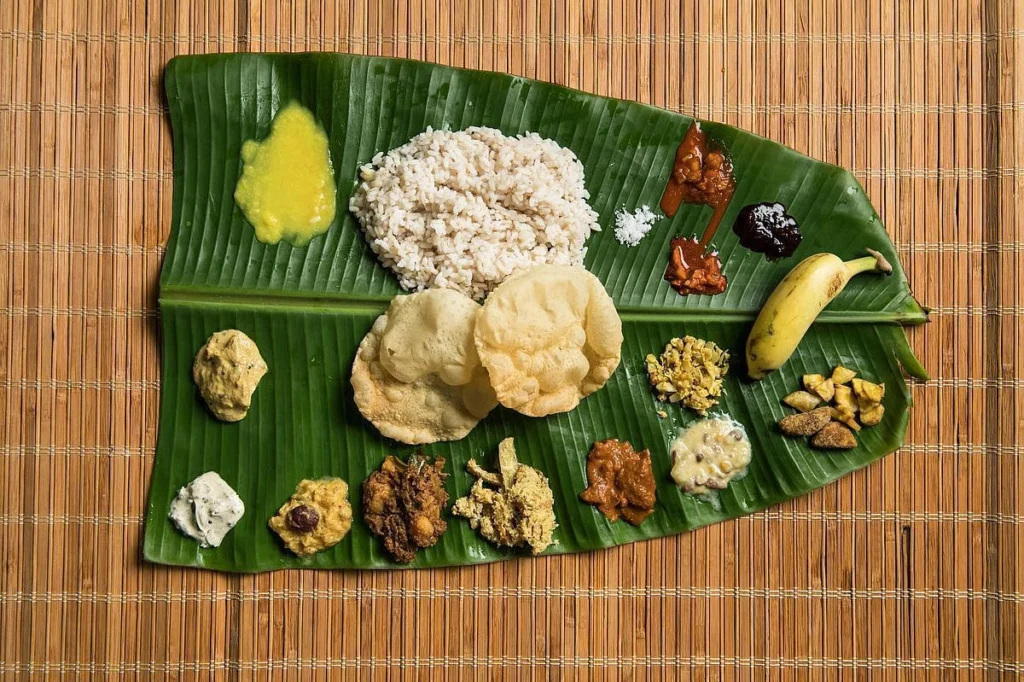
Photo — banana leaf meal
Chettinad: mansions built on trade
Chettinad cuisine, already discussed, is only part of the Chettiar story. The Nattukottai Chettiars, a merchant and banking community based in a cluster of towns in southern Tamil Nadu, built one of the more remarkable architectural legacies in the state, funded almost entirely by trade and banking connections that reached far beyond India.
Trading across the Bay of Bengal
From the 19th century onward, Chettiar merchants and moneylenders operated extensively across British colonial Southeast Asia — Burma, Malaya, Ceylon, Vietnam — building banking and trading networks that generated extraordinary wealth, much of which flowed back into their home towns in Chettinad.
The mansions
That wealth built some of India’s most distinctive vernacular mansions: vast houses combining Chettinad’s own building traditions with imported materials and influences gathered from across their trading world — Italian marble, Belgian glass, Burmese teak, and elaborate Athangudi tiles, a distinctive handmade cement tile tradition still produced locally today. Many of these mansions, concentrated around towns like Kanadukathan and Karaikudi, still stand — some inhabited, some converted into heritage hotels, others slowly deteriorating — a genuinely underappreciated architectural counterpart to Rajasthan’s havelis, built by a very different kind of trading community on the opposite side of the country.
A haveli’s cousin, on the other coast
Chettinad’s merchant mansions and Rajasthan’s havelis were built by strikingly similar kinds of communities — trading families competing with each other through architecture — separated by geography, climate and centuries, but recognisably the same impulse.
Modern Tamil Nadu: language, cinema and the coast
Madras to Chennai
The British East India Company established Fort St. George on this coast in 1639, and the settlement that grew around it became Madras, one of British India’s original three major port cities alongside Bombay and Calcutta. Renamed Chennai in 1996, the city is now one of India’s most significant industrial and technology hubs, with a large automotive manufacturing sector substantial enough to earn it the nickname “the Detroit of India,” alongside a growing IT and healthcare industry that has made it one of South India’s most important economic centres.
The Dravidian movement
Tamil Nadu’s modern politics were reshaped in the mid-20th century by the Self-Respect Movement and the broader Dravidian political tradition that grew from it — built substantially around Tamil linguistic pride and resistance to the imposition of Hindi as a national language. That movement remains the dominant framework of Tamil Nadu’s politics today, distinct from most of the rest of India, and it ties directly back to the same deep attachment to language explored earlier in this guide.
Cinema
The Tamil film industry, often called Kollywood, has been deeply intertwined with Dravidian politics for decades — several of Tamil Nadu’s most influential chief ministers began as screenwriters or film stars, and cinema remains one of the most powerful cultural forces in the state, shaping language, fashion and public sentiment well beyond the screen.
A coastline still looking outward
The same coast that once launched Chola fleets toward Southeast Asia later sent, under far less glorious circumstances, Tamil indentured labourers to British colonial plantations in Malaya, Ceylon, Fiji and South Africa through the 19th and early 20th centuries. Tamil communities remain a significant, visible presence in Singapore and Malaysia today — a very different kind of migration from the Chola navy’s, but pointed in a strikingly similar direction, from a coastline that has been looking outward for a very long time.
The same coast that once launched Chola fleets outward later sent Tamil families outward in a very different way — but in strikingly the same direction.
Travelling Tamil Nadu
As with Kerala, it’s more useful to group Tamil Nadu the way its geography and history already do, rather than as a flat list of sights.
Practical notes
- Season. November to February is by far the most comfortable window; April through June brings genuinely extreme heat across the interior and delta regions.
- Chennai’s December music season is worth building a trip around if classical Indian arts interest you — weeks of concerts and dance performances across the city.
- Temple towns are working religious sites, not museums — dress modestly, expect specific entry rules at some temples (including, at a few, restrictions on non-Hindu visitors to the innermost sanctum), and be mindful of ritual timings.
- Distances between temple towns are real — Thanjavur, Madurai and Chidambaram aren’t adjacent, so plan travel time generously rather than trying to compress the whole circuit.
- Filter coffee stops are less a tourist activity than a genuine local ritual — worth pausing for, ideally more than once a day.
- Temple festival timing can transform a visit to Madurai or any major temple town — check the local festival calendar before finalising dates.
Next in the South India deep dive: Karnataka, from the Deccan plateau to Bengaluru.
Curious about temple towns, Chola history, or the Tamil coast firsthand? Message me on WhatsApp.